Oh. I thought you were just teasing him because you certainly won't be hearing any pops from anything back towards V1 once you pull the PI tube. But I guess you were serious, eh?Stevem wrote: ↑Sat Dec 28, 2019 11:52 am Well you may think it's very funny, but when you do repairs for a living and you need to get things done fast to give a accurate estimate of the time / labor that will involved in the repair to the owner, this method works fine and no harm comes to the amp!
Yes " it's cool"
Just don't plug the tubes back in with the standby switch on so you don't set the tube back in wrong.
BASSMAN WITH VERY LITTLE VOLUME
Moderators: pompeiisneaks, Colossal
Re: BASSMAN WITH VERY LITTLE VOLUME
Re: BASSMAN WITH VERY LITTLE VOLUME
The jack's sleeve/common terminal is obvious, but the photos don't show which lug is hot/tip and which is the switch; have you verified that? Seem to be using the middle lug as the switch, but different manufacturer's have them in different arrangements, though at first glance they may all look the same.
See above.
So the other jack in the photo isn't connected?
The assess the appropriateness of that, have you checked the power tube plate or cathode current at idle?
https://www.justgiving.com/page/5-in-5-for-charlie This is my step son and his family. He is running 5 marathons in 5 days to support the research into STXBP1, the genetic condition my grandson Charlie has. Please consider supporting him!

Re: BASSMAN WITH VERY LITTLE VOLUME
Genius observations, PS! I remedied what you found with good, clean additions of solder to all such appearing turrets and wires on the board, still the same output. The shorting jacks I'm using came with my kit and they are wired identically in my quite successful Deluxe 5E3 build. Not sure why they wouldn't work here. I lack the experience and intuition to know what to do.pompeiisneaks wrote: ↑Sat Dec 28, 2019 6:39 pm Quite a few of those turrets look like they've got little to no solder in them. They may need to be touched up to get better connection. In some cases if you don't have a good physical connection and there's not enough solder, the flux can create a resistive effect causing less current to flow through those joints. You may want to hit them again with a bit more solder. here:
somesolder.png
Also I think I see one of the input wires not soldered at all, here:
nosolder.png
~Phil
Just plug it in, man.
Re: BASSMAN WITH VERY LITTLE VOLUME
If the lugs are 10, 12, and 2 o'clock and the tip connector is at 6 o'clock, the 2 o'clock lug is connected to the tip connector in all of these jacks. The shorting lug is at 12 o'clock and the sleeve is at 10.pdf64 wrote: ↑Sat Dec 28, 2019 7:07 pmThe jack's sleeve/common terminal is obvious, but the photos don't show which lug is hot/tip and which is the switch; have you verified that? Seem to be using the middle lug as the switch, but different manufacturer's have them in different arrangements, though at first glance they may all look the same.
See above.
So the other jack in the photo isn't connected?
The assess the appropriateness of that, have you checked the power tube plate or cathode current at idle?
The jack below the output jack is not connected to anything at the moment. It's there to see if I had room for a future tone stack bypass pedal.
How do I check the plate and cathode current? On the socket pins?
Just plug it in, man.
Re: BASSMAN WITH VERY LITTLE VOLUME
NEW PROBLEM. I decided to make sure my speaker wiring wasn't in the way. I'm using a 410 spider junction cable. I pulled the end housing off and thought the cloth could be cleaner, so I unsoldered the connector, recut and shrink-wrapped the hot wire connection to keep it tidy, screwed it back together as below:
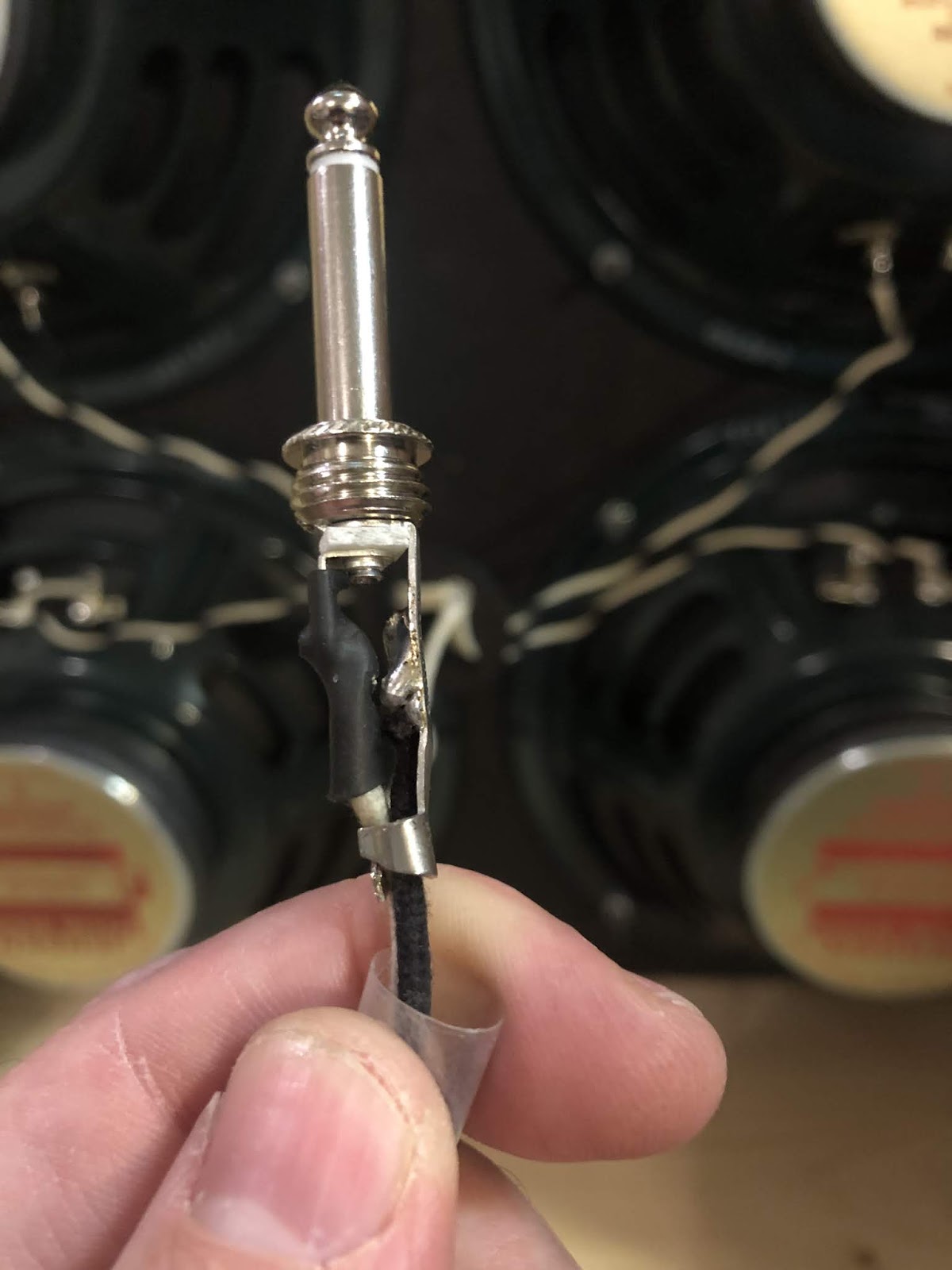
NOW, I KNOW, I KNOW, If Darth Vader runs out of carbonite, he can always hire me to solder Han Solo into cryosleep, JUST LIKE I HOSED DOWN THAT CABLE. After I posted that picture, I went back in and trimmed the solder and separated the wires better. Fixed? NO!
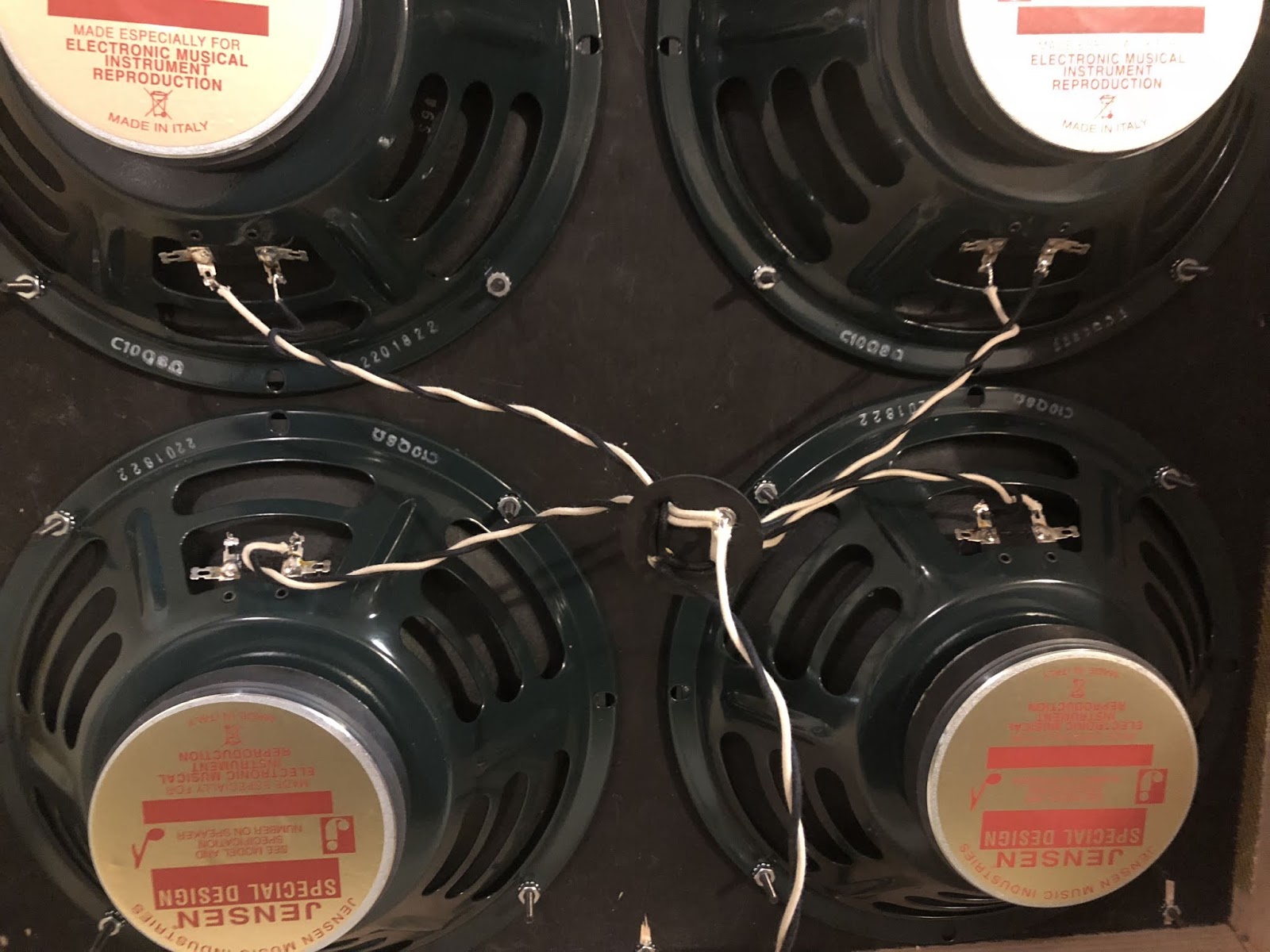
NOW when I turn the amp out of standby I get a much louder hiss and squeal that doesn't transmit the guitar sound at all. Just either a constant high-pitched squeal, or an alternation between silence and mounting, incredibly loud warbling. WTF?
I'm about to go garbage man on this f@&king build.
NOW, I KNOW, I KNOW, If Darth Vader runs out of carbonite, he can always hire me to solder Han Solo into cryosleep, JUST LIKE I HOSED DOWN THAT CABLE. After I posted that picture, I went back in and trimmed the solder and separated the wires better. Fixed? NO!
NOW when I turn the amp out of standby I get a much louder hiss and squeal that doesn't transmit the guitar sound at all. Just either a constant high-pitched squeal, or an alternation between silence and mounting, incredibly loud warbling. WTF?
I'm about to go garbage man on this f@&king build.
Just plug it in, man.

Re: BASSMAN WITH VERY LITTLE VOLUME
That's actually a huge improvement! You've got your OT primary wires reversed, and you're getting positive instead of negative feedback, which causes the howling and motorboating. I'm looking at the graphical layout image: just swap the yellow and orange wires that go to pins 5 of your power tubes.
I build and repair tube amps. http://amps.monkeymatic.com
Re: BASSMAN WITH VERY LITTLE VOLUME
In my naïveté, I need clarification:xtian wrote: ↑Sun Dec 29, 2019 1:42 am That's actually a huge improvement! You've got your OT primary wires reversed, and you're getting positive instead of negative feedback, which causes the howling and motorboating. I'm looking at the graphical layout image: just swap the yellow and orange wires that go to pins 5 of your power tubes.
See the following diagram of the Bassman OT green and black wires:
https://www.mojotone.com/amp-parts/Tran ... ransformer
The black wire is “0” and the green wire is the 2 ohm tap. Still reversed?
Swapping the yellow and orange pin 5 wires would swap the V4 and V5 positions. Is this good? Since both wires go to an individual 220k resistor and then parallel connect to the bias divider, how would this make a difference? Thank you!
Just plug it in, man.
Re: BASSMAN WITH VERY LITTLE VOLUME
Check this out!xtian wrote: ↑Sun Dec 29, 2019 1:42 am That's actually a huge improvement! You've got your OT primary wires reversed, and you're getting positive instead of negative feedback, which causes the howling and motorboating. I'm looking at the graphical layout image: just swap the yellow and orange wires that go to pins 5 of your power tubes.
https://www.mojotone.com/kits/TweedAmpK ... le-Amp-Kit
I think I mistakenly misrouted the wires you mentioned. Looking at the diagram at this link, the pin 5 output tube wires cross: the V4 to the left gridstop turret and the V5 to the right. I’ll switch the wires and see what happens.
I’m off to Disneyland with the wife and kids until next weekend, D4MN IT ALL!!! I will return and report.
Just plug it in, man.
-
wpaulvogel
- Posts: 448
- Joined: Wed Jan 23, 2019 3:11 am
- Location: Leesburg Georgia
- Contact:
1 others liked this
Re: BASSMAN WITH VERY LITTLE VOLUME
If you’re anything like me, I have a hard time concentrating on vacations when I a amp problem at home. Hopefully it won’t be the case, enjoy your trip.
-
Stevem
- Posts: 5144
- Joined: Fri Jan 24, 2014 3:01 pm
- Location: 1/3rd the way out one of the arms of the Milkyway.
1 others liked this
Re: BASSMAN WITH VERY LITTLE VOLUME
Ten over, I did not mean that you yank the tube out and then leave it out!
sorry for the confusion!
sorry for the confusion!
When I die, I want to go like my Grandfather did, peacefully in his sleep.
Not screaming like the passengers in his car!
Cutting out a man's tongue does not mean he’s a liar, but it does show that you fear the truth he might speak about you!
Not screaming like the passengers in his car!
Cutting out a man's tongue does not mean he’s a liar, but it does show that you fear the truth he might speak about you!
Re: BASSMAN WITH VERY LITTLE VOLUME
THANKS, MAN!wpaulvogel wrote: ↑Sun Dec 29, 2019 11:33 am If you’re anything like me, I have a hard time concentrating on vacations when I a amp problem at home. Hopefully it won’t be the case, enjoy your trip.
Just plug it in, man.
Re: BASSMAN WITH VERY LITTLE VOLUME
IT IS FIXED AND FULLY FUNCTIONAL!!! AND *LOUD*!!! THANK YOU ALL!!!ViperDoc wrote: ↑Sun Dec 29, 2019 6:55 amCheck this out!xtian wrote: ↑Sun Dec 29, 2019 1:42 am That's actually a huge improvement! You've got your OT primary wires reversed, and you're getting positive instead of negative feedback, which causes the howling and motorboating. I'm looking at the graphical layout image: just swap the yellow and orange wires that go to pins 5 of your power tubes.
https://www.mojotone.com/kits/TweedAmpK ... le-Amp-Kit
I think I mistakenly misrouted the wires you mentioned. Looking at the diagram at this link, the pin 5 output tube wires cross: the V4 to the left gridstop turret and the V5 to the right. I’ll switch the wires and see what happens.
I’m off to Disneyland with the wife and kids until next weekend, D4MN IT ALL!!! I will return and report.
I just got back from the family trip, walked straight into the garage and swapped the wires coming off the power tubes to the grid stop resistors(?). I swapped them by mistake by missing that they cross each other at the board. I cooled the iron, plugged in my cab and guitar and BAM!!! Rock and Roll!!! This sucker is LOUD.
This leads to a very important question. Why does this matter? I understand that positive feedback is a result of improper phasing, right? And by reversing the phase, we get negative feedback which we want. What I see on JTM45 (veritable Bassman copy) diagrams is that the V4/V5 wires don't cross at all, it seems. I suppose by the end of the circuit, that has been rectified somehow, but how does that work?
Just plug it in, man.
Re: BASSMAN WITH VERY LITTLE VOLUME
Congrats!
Hooking up the OT primary with the correct polarity is a coin flip. It's impossible to know in advance--you just have to try it...and lead enough length in the wires to reverse them if needed! This happens with every build that has gNFB.
Hooking up the OT primary with the correct polarity is a coin flip. It's impossible to know in advance--you just have to try it...and lead enough length in the wires to reverse them if needed! This happens with every build that has gNFB.
I build and repair tube amps. http://amps.monkeymatic.com
-
martin manning

- Posts: 14308
- Joined: Sun Jul 06, 2008 12:43 am
- Location: 39°06' N 84°30' W
Re: BASSMAN WITH VERY LITTLE VOLUME
In this case it seems the OT primaries were connected per the layout, and it was the grid leads that were swapped. Either way, same result: The signal phase at the secondary is the opposite of what it should be, and the feedback is positive. Accordingly, you could have left the grid leads as they were, and got the correct phase relationship back by swapping the OT primary leads.ViperDoc wrote: ↑Sat Jan 04, 2020 8:14 pmThis leads to a very important question. Why does this matter? I understand that positive feedback is a result of improper phasing, right? And by reversing the phase, we get negative feedback which we want. What I see on JTM45 (veritable Bassman copy) diagrams is that the V4/V5 wires don't cross at all, it seems. I suppose by the end of the circuit, that has been rectified somehow, but how does that work?
Re: BASSMAN WITH VERY LITTLE VOLUME
In this case it seems the OT primaries were connected per the layout, and it was the grid leads that were swapped. Either way, same result: The signal phase at the secondary is the opposite of what it should be, and the feedback is positive. Accordingly, you could have left the grid leads as they were, and got the correct phase relationship back by swapping the OT primary leads.martin manning wrote: ↑Sat Jan 04, 2020 8:52 pm [quote=ViperDoc post_id=406571 time=<a href="tel:1578168882">1578168882</a> user_id=20229]This leads to a very important question. Why does this matter? I understand that positive feedback is a result of improper phasing, right? And by reversing the phase, we get negative feedback which we want. What I see on JTM45 (veritable Bassman copy) diagrams is that the V4/V5 wires don't cross at all, it seems. I suppose by the end of the circuit, that has been rectified somehow, but how does that work?
[/quote]
This is all very good to know! Thanks!
Just plug it in, man.