Anybody ever rolled a preamp with a -bias voltage for the grids of 12A's?
It would be a bit annoying but could help finding the right spot for whatever the player wanted. I've been thinking about it, it is impractical but it would be cool for V1 to tame it for a clean channel or vice versa.
Wild idea, wondering if anybody has thought/done it.
Happy Halloween!
12A*7 fixed bias?
Moderators: pompeiisneaks, Colossal
-
Stevem
- Posts: 5144
- Joined: Fri Jan 24, 2014 3:01 pm
- Location: 1/3rd the way out one of the arms of the Milkyway.
Jjj
How about this?
Since tubes run at higher plate voltages have a better and tighter clean sound, and tubes run at a lower voltage clip and compress better for the dirty mode I built a amp some ten years ago that to my Dog ears sounds the best and was quite simple to do.
I used a relay to swap out the power supply dropping resistor to run the second gain stage at a lower voltage for the dirt and a higher voltage for cleans, this same relay also changed the value of the cathode resistor on that stage .
I then also have a opto coupler that gets triggered at the same time to apply another gain stage to provide the make up signal level that gets dropped off when the lower plate voltage on the dirt stage is ingaued .
The amp is layed out as a the first gain stage being both sides of a AX7, the next stage is the one that can have its plate voltage and cathode resistor switched in and out, next the make up gain stage , one more gain stage that is handled by a 12au7 , the tone stack and then long tail PI section.
Since tubes run at higher plate voltages have a better and tighter clean sound, and tubes run at a lower voltage clip and compress better for the dirty mode I built a amp some ten years ago that to my Dog ears sounds the best and was quite simple to do.
I used a relay to swap out the power supply dropping resistor to run the second gain stage at a lower voltage for the dirt and a higher voltage for cleans, this same relay also changed the value of the cathode resistor on that stage .
I then also have a opto coupler that gets triggered at the same time to apply another gain stage to provide the make up signal level that gets dropped off when the lower plate voltage on the dirt stage is ingaued .
The amp is layed out as a the first gain stage being both sides of a AX7, the next stage is the one that can have its plate voltage and cathode resistor switched in and out, next the make up gain stage , one more gain stage that is handled by a 12au7 , the tone stack and then long tail PI section.
When I die, I want to go like my Grandfather did, peacefully in his sleep.
Not screaming like the passengers in his car!
Cutting out a man's tongue does not mean he’s a liar, but it does show that you fear the truth he might speak about you!
Not screaming like the passengers in his car!
Cutting out a man's tongue does not mean he’s a liar, but it does show that you fear the truth he might speak about you!
Re: 12A*7 fixed bias?
Plenty of examples of fixed-bias pre-amp stages, mostly on Cathodyne or CF stages where there is high cathode voltage. Merlin Blencowe covers this in his 'designing tube pre-amps...' books.Xander8280 wrote:Anybody ever rolled a preamp with a -bias voltage for the grids of 12A's?
It would be a bit annoying but could help finding the right spot for whatever the player wanted. I've been thinking about it, it is impractical but it would be cool for V1 to tame it for a clean channel or vice versa.
Wild idea, wondering if anybody has thought/done it.
Happy Halloween!
However there's little real advantage in using fixed biasing instead of cathode biasing, due to the high parts count of fixed biasing (in comparison to cathode biasing), and the lack of any real performance advantage.
Making the grid -vely biased wouldn't make any difference to the overall gain of your run-of-the mill 12AX7, because you'd only gain 1-2 volts of plate-to-cathode voltage anyhow (compared to 1-3hundy extant plate-to-cathode volts).
He who dies with the most tubes... wins
Re: 12A*7 fixed bias?
Use of diode / LED in place of the cathode resistor results in fixed bias, ie bias voltage remains constant whatever the cathode current.
Grid leak bias might be seen as operating with a negative voltage on the grid.
Grid leak bias might be seen as operating with a negative voltage on the grid.
https://www.justgiving.com/page/5-in-5-for-charlie This is my step son and his family. He is running 5 marathons in 5 days to support the research into STXBP1, the genetic condition my grandson Charlie has. Please consider supporting him!
I was just thinking...
Was it today or last year I was thinking something like that. The ADA MP1, (I think that's the name), that amp and other early programmable amps must use switch arrays to select various resistor and cap values in order to obtain the various voicing s that are stored in memory and recalled according to pre-sets. Initially the multi-voiced amps only had about 8 different models. Not nearly as complicated as the newer ones with 99 Amps and 50 Cabinet models.
I too am currently thinking through what it would take to alter the harmonics of a couple of gain stages. Cathode resistors variable.
I've asked this question in other places and never really gotten a good answer- What about using a variactor- A diode based variable capacitor in place of the capacitance values.
silverfox.
I too am currently thinking through what it would take to alter the harmonics of a couple of gain stages. Cathode resistors variable.
I've asked this question in other places and never really gotten a good answer- What about using a variactor- A diode based variable capacitor in place of the capacitance values.
silverfox.
Re: 12A*7 fixed bias?
Fixed bias does allow more efficiency because it eliminates the series cathode resistor and the associated voltage/power drop. But with preamp stages there's very little to gain from that....there's little real advantage in using fixed biasing instead of cathode biasing, due to the high parts count of fixed biasing (in comparison to cathode biasing), and the lack of any real performance advantage.
...But it also eliminates degenerative cathode feedback so the operating (and tonal) characteristics will be different from cathode biased circuits, especially those without cathode bypass for AC frequencies. And even at DC conditions you lose cathode bias scheme's ability to modulate bias/gain in interaction with tube's current draw. In essence, fixed bias therefore gives you more clean headroom but also makes distortion onset more abrupt and clipping "harder".
It also makes the circuit much more sensitive to quite varying characteristics of tubes (as there is no self-bias mechanism to compensate differences) and more sensitive for correct bias (for same reason).
I can't rememeber any "textbook" fixed bias -guitar amp- preamp stage (with cathode grounded and grid hooked to negative voltage reference) but older Magnatone amps did use a hybrid bias setup where cathode bias voltage is derived from a voltage divider (cathode resistor + series resistor to B+). Effectively it allows to bias cathode to preferred voltage potential - but you have more margin for which cathode resistor values to use. (e.g. you can bias to same voltage potential as with 1K5 cathode resistor, but the cathode resistor doesn't have to be 1K5 as you can effect the values by modifying the whole voltage divider circuit).
I think fixed bias setups are more common for HiFi applications.
Re: 12A*7 fixed bias?
If the plate is allowed to track the cathode, you lose almost half the potential gain (in a voltage amp). Bypassed, you recover frequencies above the breakpoint. Theoretically, a fixed bias triode maintains the gain at all frequencies, but the grid voltage doesn't perfectly track the signal. Tubes are imperfect.

Re: 12A*7 fixed bias?
This caught my attention, that the circuit would be more sensitive to varying characteristics than a cathode biasteemuk wrote: In essence, fixed bias therefore gives you more clean headroom but also makes distortion onset more abrupt and clipping "harder".
It also makes the circuit much more sensitive to quite varying characteristics of tubes (as there is no self-bias mechanism to compensate differences) and more sensitive for correct bias (for same reason).
A cathode bias or self bias will not be as influenced by different tubes on that socket.
It's really about ratios.
So cathode bias would seem more forgiving to varying tube substitutions than a circuit that is designed to a certain specification and uses fixed values.
Besides that added parts count, it may be much more temperamental about what tubes are in the socket.

Tom
Don't let that smoke out!
Don't let that smoke out!
Re: 12A*7 fixed bias?
I don't know what to think about this. I have an old Hickok tester that I have calibrated as well as I can, but when testing tubes I put a Fluke DMM across the cathode connection to read current. Tubes are all over the place. New manufacture, NOS, RCA, Mullard, GE. Transconductance numbers are always in the range they should be, but current measurements vary by up to a factor of 2! With cathode bias, I assume this will do very different things. In fact, wrt to PI tubes, I always found that high current tubes sounded more interesting (almost color versus black and white interesting). So does fixed bias enhance that effect or diminish it?
Re: 12A*7 fixed bias?
I suspect that fixed bias may diminish that effect, by facilitating the variance noted.
Cathode bias tends to act such that most all tubes settle down to a broadly similar current.
Cathode bias tends to act such that most all tubes settle down to a broadly similar current.
https://www.justgiving.com/page/5-in-5-for-charlie This is my step son and his family. He is running 5 marathons in 5 days to support the research into STXBP1, the genetic condition my grandson Charlie has. Please consider supporting him!
Re: 12A*7 fixed bias?
Fixed bias CFteemuk wrote:...
I can't rememeber any "textbook" fixed bias -guitar amp- preamp stage
[img:218:233]http://www.valvewizard.co.uk/accf3.jpg[/img]
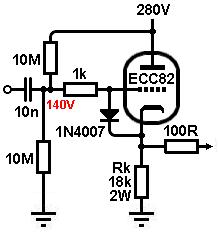
Fixed bias cathodyne (on LHS)
[img:300:281]http://www.valvewizard.co.uk/cathodyne4.jpg[/img]
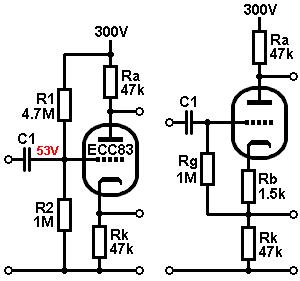
Fixed biasing in a cascode (upper triode)
[img:183:339]http://www.valvewizard.co.uk/Cascode2.jpg[/img]
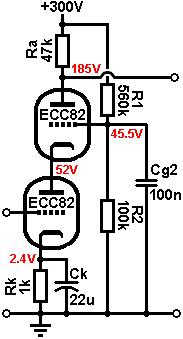
He who dies with the most tubes... wins
-
gingertube
- Posts: 531
- Joined: Mon Nov 14, 2011 2:29 am
- Location: Adelaide, South Oz
Re: 12A*7 fixed bias?
Look at V2b on sheet 1 of this schematic.
http://bmamps.com/Schematics/marshall/6 ... ematic.pdf
This switchable bias point circuit has been used by many maufacturers in many amps, usually where this one is used, as the 2nd stage of a brown/crunch channel. The operating point changes significantly when you switch that -15V on or off. At lower idle currents you are operating on a more curved section of the rp vs Ip curve, that gives more distortion and more higher order distortion components.
Cheers,
Ian
http://bmamps.com/Schematics/marshall/6 ... ematic.pdf
This switchable bias point circuit has been used by many maufacturers in many amps, usually where this one is used, as the 2nd stage of a brown/crunch channel. The operating point changes significantly when you switch that -15V on or off. At lower idle currents you are operating on a more curved section of the rp vs Ip curve, that gives more distortion and more higher order distortion components.
Cheers,
Ian
Re: 12A*7 fixed bias?
^ Those cathode follower and cathodyne circuits have fixed grid DC potential, but cathode voltage swings all over the place and on that part it acts very much like mix of grid/fixed and cathode bias schemes.
So yes, bias point matters a lot. How you derive that bias point (fixed vs. self) possibly not that much. In theory the tube only cares about the grid-cathode voltage, in practice the utilised circuits are different and so is the end result.
I haven't seen that much of switchable bias schemes, but IMO there is not much difference on building a two-channel amp where signal paths of those gain stages deliberately have different bias points. The effect is the same. Gain stages bias to different points in loadline and have different symmetry/asymmetry characteristics of clipping. DC offsets "crawl" due to capacitive coupling, and ultimately this all creates different harmonic distortion characteristic and "feel".This switchable bias point circuit has been used by many maufacturers in many amps, usually where this one is used, as the 2nd stage of a brown/crunch channel. The operating point changes significantly when you switch that -15V on or off.
So yes, bias point matters a lot. How you derive that bias point (fixed vs. self) possibly not that much. In theory the tube only cares about the grid-cathode voltage, in practice the utilised circuits are different and so is the end result.