
Have any of you guys tried a latching switch circuit for switching the channels and other things on an amp (like a Dumble)?
I have never liked the loud clicks from the traditional footswitches, especially if recording.
So my idea is to use a quiet momentary push switch along with a bypass circuit to achieve this.
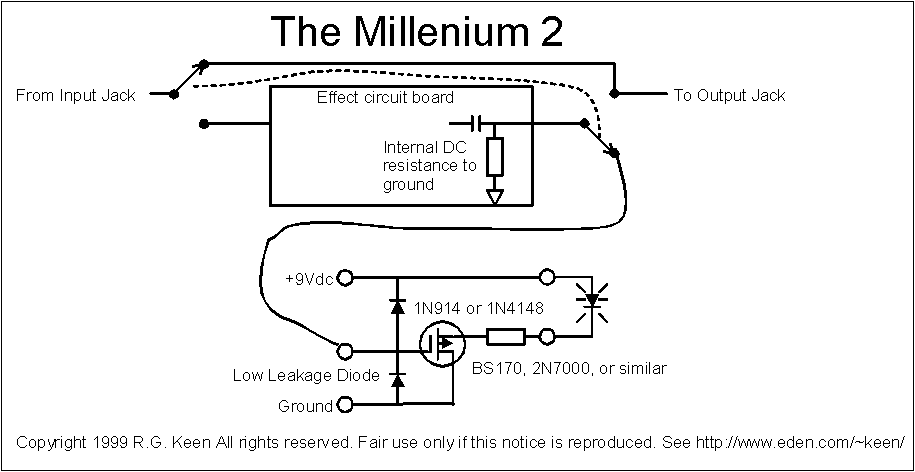
I think the Millenium 2 Switch by R.G Keen would work but is there a simpler approach?
[img:915:472]http://geofex.com/Article_Folders/Millenium/milckt3.gif[/img]
Latching Relay Switching
Moderators: pompeiisneaks, Colossal
Latching Relay Switching
Tom
Don't let that smoke out!
Don't let that smoke out!
-
JazzGuitarGimp

- Posts: 2357
- Joined: Mon Jul 23, 2012 4:54 pm
- Location: Northern CA
Re: Latching Relay Switching
That looks pretty simple, assuming it works. I'd just throw a flip flop at it, but that's going to be a bit more involved.
Lou Rossi Designs
Printed Circuit Design & Layout,
and Schematic Capture
Printed Circuit Design & Layout,
and Schematic Capture
Re: Latching Relay Switching
Yeah I did think about using a logic chip but one of the problems with some of these switching designs is that they don't switch instantly like a regular relay does with an on/off switch.
The first Millenium switch suffered from that and #2 is supposed to improve upon that.
I saw another circuit that uses transistors pictured below.
The first Millenium switch suffered from that and #2 is supposed to improve upon that.
I saw another circuit that uses transistors pictured below.
You do not have the required permissions to view the files attached to this post.
Tom
Don't let that smoke out!
Don't let that smoke out!
-
JazzGuitarGimp
- Posts: 2357
- Joined: Mon Jul 23, 2012 4:54 pm
- Location: Northern CA
Re: Latching Relay Switching
That's a lot of parts. There would be just the slightest delay (probably couldn't detedt it) with a FF circuit, and the amount of delay would be dependant on the switch debounce filter values. But we're talking a total of six parts;Structo wrote:Yeah I did think about using a logic chip but one of the problems with some of these switching designs is that they don't switch instantly like a regular relay does with an on/off switch.
The first Millenium switch suffered from that and #2 is supposed to improve upon that.
I saw another circuit that uses transistors pictured below.
Flip Flop chip
PS decoupling cap for the FF
R and C switch debounce filter
General purpose NPN transistor to switch the relay coil
R to base of transistor.
Plus, if your relay coil is in the 6 to 12V range, you could use a 4000 series FF, which runs nicely on anywhere fron 6V up to 18V, so no need for a regulator.
Not to mention, most FF chips contain two separate flops in one 14 pin package, so adding a second relay control would require just four more parts; a transistor, two R's and a C.
Lou Rossi Designs
Printed Circuit Design & Layout,
and Schematic Capture
Printed Circuit Design & Layout,
and Schematic Capture
-
VacuumVoodoo

- Posts: 924
- Joined: Fri Feb 17, 2006 6:27 pm
- Location: Goteborg, Sweden
- Contact:
Re: Latching Relay Switching
I found that with more than 2-3 relays de-clicking all becomes cumbersome. So I use a muting circuit on PA input. The trick is to trigger the muting pulse NOT by a relay contact bonce pulse but directly from the foot switch using its bounce pulse as trigger. That way it should be possible to mute PA input a millisecond or two before the relay reacts to its On/OFF control signal. That's where I hit the first ambush. The first bounce from foot switch can have either a rising or falling leading edge...so need to design a circuit that reacts to both.
I am not claiming credit for the circuit that ended up as the heart of it, found it in EDN of March 4, 1999. Check attached PDF.
I used a LM311 comparator as interface between this cirtuit and foot switch, two diodes form an OR gate driving a discrete transistor's base to turn a H11F1 optofet on for predetermined period of time set by a trimpot in R2 position in the circuit in the PDF.
It ended up on a small PCB, works on 5 to 15V DC supply.
A mute time 15-20ms stops pops & clicks from all but the slowest relays.
This can be converted to SMT and made as big as a post stamp or smaller.
[img:480:265]http://tubewonder.com/zagraypics/thepre ... killer.jpg[/img]
I am not claiming credit for the circuit that ended up as the heart of it, found it in EDN of March 4, 1999. Check attached PDF.
I used a LM311 comparator as interface between this cirtuit and foot switch, two diodes form an OR gate driving a discrete transistor's base to turn a H11F1 optofet on for predetermined period of time set by a trimpot in R2 position in the circuit in the PDF.
It ended up on a small PCB, works on 5 to 15V DC supply.
A mute time 15-20ms stops pops & clicks from all but the slowest relays.
This can be converted to SMT and made as big as a post stamp or smaller.
[img:480:265]http://tubewonder.com/zagraypics/thepre ... killer.jpg[/img]

You do not have the required permissions to view the files attached to this post.
Aleksander Niemand
------------------------
Life's a party but you get invited only once...
affiliation:TUBEWONDER AMPS
Zagray!-review
------------------------
Life's a party but you get invited only once...
affiliation:TUBEWONDER AMPS
Zagray!-review
Re: Latching Relay Switching
Thanks!JazzGuitarGimp wrote: That's a lot of parts. There would be just the slightest delay (probably couldn't detedt it) with a FF circuit, and the amount of delay would be dependant on the switch debounce filter values. But we're talking a total of six parts;
Flip Flop chip
PS decoupling cap for the FF
R and C switch debounce filter
General purpose NPN transistor to switch the relay coil
R to base of transistor.
Plus, if your relay coil is in the 6 to 12V range, you could use a 4000 series FF, which runs nicely on anywhere fron 6V up to 18V, so no need for a regulator.
Not to mention, most FF chips contain two separate flops in one 14 pin package, so adding a second relay control would require just four more parts; a transistor, two R's and a C.
That second schematic shows a debounce circuit with C1, R5 and R1.
Here is the description for it:
When the circuit is powered up, all of the transistors are off and stay off. C1 gets pulled up to Vp. When the switch is pushed, Q3 and Q2 turn on, since their base is pulled up. Q1 and Q4 are in turned on as well. Q1 keeps Q2 turned on and Q2 keeps Q3 turned on and Q3 keeps Q4 turned on. Q4 supplies current to the load. When Q2 is asserted it keeps pin 1 of SW1 at ground.
When the switch is pulled low again, the base of Q3 is tied to ground, because Q2 is on, and the chain is broken and all of the transistors turn off.
C1 and R1 and R5 form the time constant for the debounce circuit. Adjust these values for an appropriate debounce time.
It's been a lot of years since I have used any logic chips and I did learn about them about 40 years ago..... just not sure how robust or dependable it would be in a tube amp.
If you feel like making a rough schematic I would appreciate it.
Or maybe I just need to find some quieter footswitches.

OH, and thanks Aleksander, that circuit is kind of advanced for me.

Tom
Don't let that smoke out!
Don't let that smoke out!
-
JazzGuitarGimp
- Posts: 2357
- Joined: Mon Jul 23, 2012 4:54 pm
- Location: Northern CA
Re: Latching Relay Switching
Hi Tom,
I'd be happy to do a schematic for you. We've got a thunderstorm going on at the moment. Lost power 20-minutes ago. I'm typing on my verizoc-connected iPad, which is useless when it comes to schematic capture. I'll post a schematc shortly after the power is back on.
Lou
I'd be happy to do a schematic for you. We've got a thunderstorm going on at the moment. Lost power 20-minutes ago. I'm typing on my verizoc-connected iPad, which is useless when it comes to schematic capture. I'll post a schematc shortly after the power is back on.
Lou
Lou Rossi Designs
Printed Circuit Design & Layout,
and Schematic Capture
Printed Circuit Design & Layout,
and Schematic Capture
-
JazzGuitarGimp
- Posts: 2357
- Joined: Mon Jul 23, 2012 4:54 pm
- Location: Northern CA
Re: Latching Relay Switching
Hi Tom,
Schematic pdf attached. This circuit uses the TI CD4013BE Dual D-Type Flip Flop (Mouser $0.52). It is rated for operation from 3VDC to 18VDC, though in the schematic, I have indicated a supply range of +4VDC to +16VDC. +16V may be pushing it if the supply is not regulated. I'd suggest keeping the supply voltage at or below +12V if unregulated. Keep the power supply decoupling cap (C1) as close to pin 14 as possible. Notice the connection from the /Q output to the Data input (pin 2 to pin 5).
I've included an optional POR circuit. Without it, the relay may land in the on-state or the off-state when power is first applied to the circuit. If you can live with this, then there is no need for the POR circuit, though it is just two additional components. Both flip flops can be driven by the one POR signal, so no need for additional R and C if you use both halves of the flop.
Wire the second flop just like the first one if you need to control two separate relays with a separate footswitch for each. If unused, make sure you ground the Set and Reset pins to keep the outputs from free-running and destroying the chip.
Send me a PM if you have any questions.
CD4013BE data sheet: [http://www.ti.com/lit/ds/schs023d/schs023d.pdf]
HTH,
Lou
One caveat: the clock input triggers on the rising edge, so if you press and hold the switch, the relay won't engage / disengage until you release the switch. This can be fixed by swapping the pisitions of R2 & C2, and connecting the left side of the switch to +V_RLY, rather than GND. I figured this wouldn't be an issue, and that it is slightly better to send GND and a current-limited +V_RLY down the cable, rather than a full-current +V_RLY and current-limited GND.
Schematic pdf attached. This circuit uses the TI CD4013BE Dual D-Type Flip Flop (Mouser $0.52). It is rated for operation from 3VDC to 18VDC, though in the schematic, I have indicated a supply range of +4VDC to +16VDC. +16V may be pushing it if the supply is not regulated. I'd suggest keeping the supply voltage at or below +12V if unregulated. Keep the power supply decoupling cap (C1) as close to pin 14 as possible. Notice the connection from the /Q output to the Data input (pin 2 to pin 5).
I've included an optional POR circuit. Without it, the relay may land in the on-state or the off-state when power is first applied to the circuit. If you can live with this, then there is no need for the POR circuit, though it is just two additional components. Both flip flops can be driven by the one POR signal, so no need for additional R and C if you use both halves of the flop.
Wire the second flop just like the first one if you need to control two separate relays with a separate footswitch for each. If unused, make sure you ground the Set and Reset pins to keep the outputs from free-running and destroying the chip.
Send me a PM if you have any questions.
CD4013BE data sheet: [http://www.ti.com/lit/ds/schs023d/schs023d.pdf]
HTH,
Lou
One caveat: the clock input triggers on the rising edge, so if you press and hold the switch, the relay won't engage / disengage until you release the switch. This can be fixed by swapping the pisitions of R2 & C2, and connecting the left side of the switch to +V_RLY, rather than GND. I figured this wouldn't be an issue, and that it is slightly better to send GND and a current-limited +V_RLY down the cable, rather than a full-current +V_RLY and current-limited GND.
You do not have the required permissions to view the files attached to this post.
Lou Rossi Designs
Printed Circuit Design & Layout,
and Schematic Capture
Printed Circuit Design & Layout,
and Schematic Capture
Re: Latching Relay Switching
Wow!
Thanks a lot Lou!
I will experiment with this circuit as soon as I can get the parts.
Thanks a lot Lou!
I will experiment with this circuit as soon as I can get the parts.
Tom
Don't let that smoke out!
Don't let that smoke out!
-
JazzGuitarGimp
- Posts: 2357
- Joined: Mon Jul 23, 2012 4:54 pm
- Location: Northern CA
Re: Latching Relay Switching
You are most welcome! Hit me up with a PM if you have any questions, as I don't always see additional posts in threads I've posted in.Structo wrote:Wow!
Thanks a lot Lou!
I will experiment with this circuit as soon as I can get the parts.
Also, one more "trick". with this circuit: You'll probably never need this, but if you want to drive two relays, but in opposite states (one is on while the other is off) from the same footswitch, then add another 4K7 resistor and 2N3904, but connect the resistor to the /Q output (leaving it connected to the Data input) as the Q and /Q outputs are always in opposite states.
Lou Rossi Designs
Printed Circuit Design & Layout,
and Schematic Capture
Printed Circuit Design & Layout,
and Schematic Capture
Re: Latching Relay Switching
(I don't have an amp with relays but) I made a little three channel momentary debouncer using a PIC12F675. The debounce delay is configurable. Demo here. At the end of it I am setting the debounce delay. The value gets stored in EEPROM.
It would need the usual TTL relay driver, open collector what-have-you.
-- bradley
[img:637:354]https://lh6.googleusercontent.com/-DRwR ... ouncer.png[/img]
It would need the usual TTL relay driver, open collector what-have-you.
-- bradley
[img:637:354]https://lh6.googleusercontent.com/-DRwR ... ouncer.png[/img]

-
dorrisant

- Posts: 2790
- Joined: Tue Sep 21, 2010 1:27 pm
- Location: Somewhere between a river and a cornfield
- Contact:
Re: Latching Relay Switching
I use this one quite a bit for latching a DPDT single pole w/momentary. There are several ways to get it to work. It could easily be used with SPDT switches too.
http://www.thetonegod.com/tech/switches/switches.html
Not very expensive and pretty similar in parts count to the above examples. Matter of fact, it uses the 4013 and a 4066, so it may be exactly the same as what Lou posted above... I can't open the file on my phone. Using the 4013 for pedal bypass switching is rock-solid at 9v all day. I have tested it with satisfactory results at 6v with the idea of tapping a filament supply but haven't actually implemented it. Need to revisit this.
I have a pcb design for this with momentary switch if you are interested. You would have to use DIYLayout Creator to manipulate the file though.
Tony
http://www.thetonegod.com/tech/switches/switches.html
Not very expensive and pretty similar in parts count to the above examples. Matter of fact, it uses the 4013 and a 4066, so it may be exactly the same as what Lou posted above... I can't open the file on my phone. Using the 4013 for pedal bypass switching is rock-solid at 9v all day. I have tested it with satisfactory results at 6v with the idea of tapping a filament supply but haven't actually implemented it. Need to revisit this.
I have a pcb design for this with momentary switch if you are interested. You would have to use DIYLayout Creator to manipulate the file though.
Tony
"Education is what you're left with after you have forgotten what you have learned" - Enzo
Easier?
While the info contained in the above posts will surely work, I like simplicity!
In looking for options to use on a new build, I ran across these! There are other configurations available, but the combination of NO+NC controls on a single chip looks ideal for amp use. Also, they are no more expensive than standard relays. And, I have found a simple 6VDC supply with a dropping resistor to the LED control pins works well.
a'doc1
In looking for options to use on a new build, I ran across these! There are other configurations available, but the combination of NO+NC controls on a single chip looks ideal for amp use. Also, they are no more expensive than standard relays. And, I have found a simple 6VDC supply with a dropping resistor to the LED control pins works well.
a'doc1
You do not have the required permissions to view the files attached to this post.
Re: Latching Relay Switching
I kind of forgot about those chips.
I think UR12 (Dana) and somebody else had talked about these.
In looking at the specs, if there is a 5ms switching time, do you notice the
time it switches?
Does it fade in or is it a sudden switching like a relay?
I think UR12 (Dana) and somebody else had talked about these.
In looking at the specs, if there is a 5ms switching time, do you notice the
time it switches?
Does it fade in or is it a sudden switching like a relay?
Tom
Don't let that smoke out!
Don't let that smoke out!
Re: Latching Relay Switching
It doesn't fade in,...it's virtually instantaneous! I suspect the switching time is much faster than a mechanical relay, as it is driven by light. And, 5000th of a second is way faster than the propagation of sound from your amp.