I'd be interested to hear what any of you use for prototyping.
My idea is something like having individual stages built on boards that I could swap around in a circuit. I also have this big sloping panel box that I thought about installing several iconic tone stacks on, perhaps with pots or trimmers for the slope resistor.
The goal isn't so much having something to tweak an existing design, which I can do with my substitution boxes in place. It's rather for experimenting with new topologies.
Prototyping systems
Moderators: pompeiisneaks, Colossal
-
LeftyStrat

- Posts: 3117
- Joined: Fri Jan 14, 2005 6:58 pm
- Location: Marietta, SC, but my heart and two of my kids are in Seattle, WA
Prototyping systems
It's never too late to have a happy childhood.
Re: Prototyping systems
That's an interesting thought. But I just build from from schematics (mine or published). Then I tweak. I've found (I think) that a lot of the "sound" is accidental.
Re: Prototyping systems
Yeah - I was wondering about this.
You can get amps with plug in modules to alter the circuit somewhat.
So why not construct the pre, pi & pwr sections on building blocks.
Breadboarding for tube amp circuits.
Hmmm.
You can get amps with plug in modules to alter the circuit somewhat.
So why not construct the pre, pi & pwr sections on building blocks.
Breadboarding for tube amp circuits.
Hmmm.
Why Aye Man
Re: Prototyping systems
I've been working on a design for a while, but I decided from the start I wanted to be able to change out part values without desoldering.
Here are a couple of Mouser parts, that I plan to use in pairs to mount plate/cathode resistors and caps.
571-14376714 Compression type
571-7969493 Screw type
One thing concerns me,..these are not rated for DC voltage. But the AC current capacity on both connectors is considerably higher than would be found in a guitar amp.
Here are a couple of Mouser parts, that I plan to use in pairs to mount plate/cathode resistors and caps.
571-14376714 Compression type
571-7969493 Screw type
One thing concerns me,..these are not rated for DC voltage. But the AC current capacity on both connectors is considerably higher than would be found in a guitar amp.

Re: Prototyping systems
Might be easier to make up a turret board with binding posts instead of turrets.
John
John
-
LeftyStrat
- Posts: 3117
- Joined: Fri Jan 14, 2005 6:58 pm
- Location: Marietta, SC, but my heart and two of my kids are in Seattle, WA
Re: Prototyping systems
This is my thought. Sort of prompted by the thread on trying stages before an EF86 stage. "What if I took the Showman two stage preamp and tone stack and put it in front of an EF86 stage?"Bob S wrote:Yeah - I was wondering about this.
You can get amps with plug in modules to alter the circuit somewhat.
So why not construct the pre, pi & pwr sections on building blocks.
Breadboarding for tube amp circuits.
Hmmm.
It would be nice to have modules swap around the order on really quickly.
It's never too late to have a happy childhood.
-
LeftyStrat
- Posts: 3117
- Joined: Fri Jan 14, 2005 6:58 pm
- Location: Marietta, SC, but my heart and two of my kids are in Seattle, WA
Re: Prototyping systems
Interesting. So I guess there are two aspects I should investigate. One is being able to swap stages and order of stages in and out quickly, and the other swapping in and out different component values quickly.ampdoc1 wrote:I've been working on a design for a while, but I decided from the start I wanted to be able to change out part values without desoldering.
Here are a couple of Mouser parts, that I plan to use in pairs to mount plate/cathode resistors and caps.
571-14376714 Compression type
571-7969493 Screw type
One thing concerns me,..these are not rated for DC voltage. But the AC current capacity on both connectors is considerably higher than would be found in a guitar amp.
It's never too late to have a happy childhood.
-
LeftyStrat
- Posts: 3117
- Joined: Fri Jan 14, 2005 6:58 pm
- Location: Marietta, SC, but my heart and two of my kids are in Seattle, WA
Re: Prototyping systems
It's never too late to have a happy childhood.

Amp Modules
Guys
Seymour Duncan built an amp like this where there were different modules you plug in for the pre and power sections. I saw it in the Guitar mags. The "Convertible"
http://www.diyguitarist.com/GuitarAmps/Convert.htm
Check it out...LOL
Seymour Duncan built an amp like this where there were different modules you plug in for the pre and power sections. I saw it in the Guitar mags. The "Convertible"
http://www.diyguitarist.com/GuitarAmps/Convert.htm
Check it out...LOL

Re: Prototyping systems
This guys builds Hi Fi amps and sells PCB's.
http://www.tubelab.com/
Pretty interesting read.
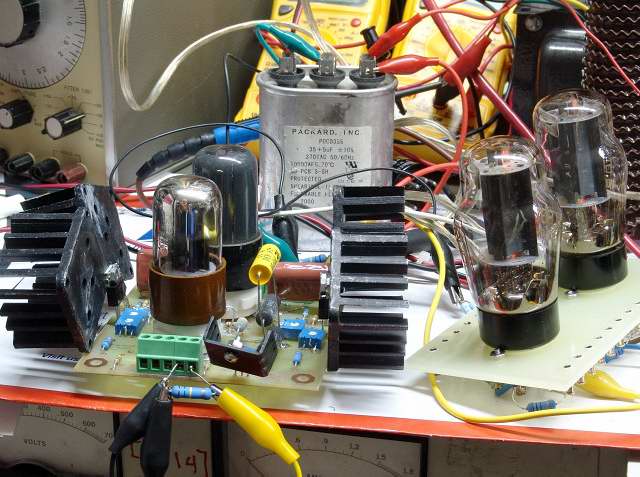
This photo shows one of his methods for finalizing his designs.
He uses sort of a modular method with power tube sockets mounted on one board and preamps on another.
Connects using clip leads.
You can make prototypes using everything from pieces of wood boards to Garolite.
[img:640:477]http://www.tubelab.com/FirstTest6L6GC_A.jpg[/img]
http://www.tubelab.com/
Pretty interesting read.
This photo shows one of his methods for finalizing his designs.
He uses sort of a modular method with power tube sockets mounted on one board and preamps on another.
Connects using clip leads.
You can make prototypes using everything from pieces of wood boards to Garolite.
[img:640:477]http://www.tubelab.com/FirstTest6L6GC_A.jpg[/img]
Tom
Don't let that smoke out!
Don't let that smoke out!
Re: Prototyping systems
Here is a Celestion Sidewinder mentioned in that article.LeftyStrat wrote:Interesting. So I guess there are two aspects I should investigate. One is being able to swap stages and order of stages in and out quickly, and the other swapping in and out different component values quickly.ampdoc1 wrote:I've been working on a design for a while, but I decided from the start I wanted to be able to change out part values without desoldering.
Here are a couple of Mouser parts, that I plan to use in pairs to mount plate/cathode resistors and caps.
571-14376714 Compression type
571-7969493 Screw type
One thing concerns me,..these are not rated for DC voltage. But the AC current capacity on both connectors is considerably higher than would be found in a guitar amp.
I have no idea if they sound good but here is one for $10
http://www.ebay.com/itm/VINTAGE-80s-CEL ... 589737e25c
Tom
Don't let that smoke out!
Don't let that smoke out!
-
markr14850
- Posts: 204
- Joined: Mon Jun 18, 2007 6:16 pm
Re: Prototyping systems
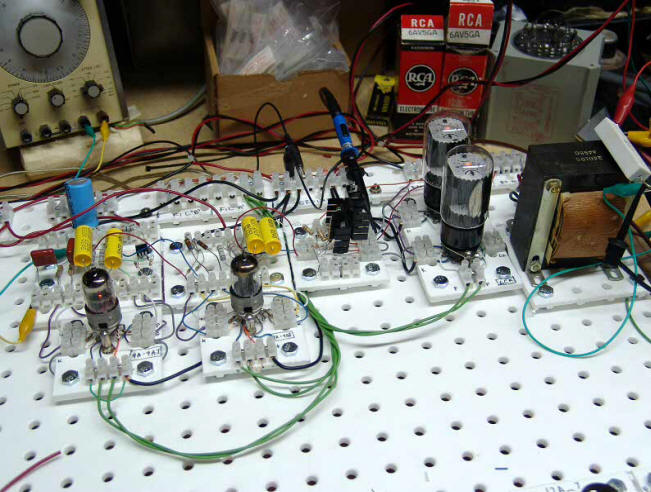
The cool prototyping on the Tubelab site can be found here:Structo wrote:http://www.tubelab.com/
http://www.tubelab.com/The_Tubelab.htm
[img:651:492]http://www.tubelab.com/images/TL3/6AV5_amp.jpg[/img]
Re: Prototyping systems
Thanks Mark I was having trouble navigating his site.
Seems a bit disorganized.
Any of you guys into Hi Fi probably are aware of Nelson Pass and his designs.
http://www.passdiy.com/index.htm
Lots of great ideas and designs there.
http://www.passdiy.com/projects.htm
Seems a bit disorganized.
Any of you guys into Hi Fi probably are aware of Nelson Pass and his designs.
http://www.passdiy.com/index.htm
Lots of great ideas and designs there.
http://www.passdiy.com/projects.htm
Tom
Don't let that smoke out!
Don't let that smoke out!
-
markr14850
- Posts: 204
- Joined: Mon Jun 18, 2007 6:16 pm
Re: Prototyping systems
One note about a tubelab style prototyping system - there will be more noise in your prototype than in a final chassis-enclosed system, due to the bath of 60hz and RF we live in.
To minimize this, you can put some sort of metal ground plane under everything. (Maybe make a cage top for it too.) If you use tube sockets with metal bases, be sure that you include a ground connection for them.
To minimize this, you can put some sort of metal ground plane under everything. (Maybe make a cage top for it too.) If you use tube sockets with metal bases, be sure that you include a ground connection for them.
Re: Prototyping systems
It sounds like you'd be better off using modules than replacing components on a board.
The PCB modules shown here from other sources are nothing new. I bought an EXEF (German company) preamp 20 years ago that allowed any two of their preamp modules to be inserted into the amp , and it also featured a built-in solid state clean channel. Don't remember all the modules available, but there were quite a few. I also made up one of my own using their PCBs (far right in the picture). I labeled it QA (or QR?), but don't remember what preamp I was modeling.
The picture shows several of the modules, each identified by the circuit it was copying.
The PCB modules shown here from other sources are nothing new. I bought an EXEF (German company) preamp 20 years ago that allowed any two of their preamp modules to be inserted into the amp , and it also featured a built-in solid state clean channel. Don't remember all the modules available, but there were quite a few. I also made up one of my own using their PCBs (far right in the picture). I labeled it QA (or QR?), but don't remember what preamp I was modeling.
The picture shows several of the modules, each identified by the circuit it was copying.
You do not have the required permissions to view the files attached to this post.