no problem...appreciate the help.mbeldyga wrote:I didn't even looked a schematic. My bad, sorry for that. It's cathode biased indeed, so about 1V looks fine - check voltages with schematic like Cliff Schecht said. Your bias caps are in place i belief. These silver electrolytic near to chassis's top.
Is this amp "redplating"?
Moderators: pompeiisneaks, Colossal
Re: Is this amp "redplating"?

Re: Is this amp "redplating"?
Bypass caps are there, they are the silver Seimens electrolytics. They're just connected to ground on the adjacent tube socket ground tab.
By looking at the schematic, they have this thing biased way hot to begin with if you follow the voltages on the schematic. Each tube is drawing 73ma, which is way over the 70% mark of ~ 56ma @ 375 Vp. Those 150 ohm Rks should be moved up to between 200 - 250 ohms to get the bias about right. Certain tubes may have handled this arrangement okay in the past, but that is seriously hot biased.
That is a pretty funky amp. Let us know how she sounds when you get the bias issue fixed.
By looking at the schematic, they have this thing biased way hot to begin with if you follow the voltages on the schematic. Each tube is drawing 73ma, which is way over the 70% mark of ~ 56ma @ 375 Vp. Those 150 ohm Rks should be moved up to between 200 - 250 ohms to get the bias about right. Certain tubes may have handled this arrangement okay in the past, but that is seriously hot biased.
That is a pretty funky amp. Let us know how she sounds when you get the bias issue fixed.
Eardrums!!! We don't need no stinkin' eardrums!

Re: Is this amp "redplating"?
I always thought on a cathode biased tube you could bias it at or close to 100% since it won't go above that due to the way they operate.
I built a push/ pull 6V6 amp last summer that I biased that way and it works fine.
Sure biasing it a little bit cooler will make the tubes last longer but I always thought the 70% rule was for fixed bias.
I built a push/ pull 6V6 amp last summer that I biased that way and it works fine.
Sure biasing it a little bit cooler will make the tubes last longer but I always thought the 70% rule was for fixed bias.
Tom
Don't let that smoke out!
Don't let that smoke out!
Re: Is this amp "redplating"?
You can usually get away with a hotter bias with cathode biased amps, but not so much as to make them redplate. 73ma is about 90%, which some tubes can take, others may glow bright red on the plates.Structo wrote:I always thought on a cathode biased tube you could bias it at or close to 100% since it won't go above that due to the way they operate.
I built a push/ pull 6V6 amp last summer that I biased that way and it works fine.
Sure biasing it a little bit cooler will make the tubes last longer but I always thought the 70% rule was for fixed bias.
Eardrums!!! We don't need no stinkin' eardrums!
-
Cliff Schecht
- Posts: 2629
- Joined: Wed Dec 30, 2009 7:32 am
- Location: Austin
- Contact:
Re: Is this amp "redplating"?
I see the how the cathode caps are connected now, you guys are right. I agree that the bias is WAY too hot though, even with cathode bias you are still dissipating too much power for just about any "standard" guitar tube to handle. Dartanion is right, you should look into replacing those 150 Ohm resistors with a slightly higher value. It probably won't affect the sound much, but it will sure make those expensive output tubes last a lot longer!
Also, do you guys not agree that he should look into replacing all of those electrolytics? They're at least 30 years old..
Also, do you guys not agree that he should look into replacing all of those electrolytics? They're at least 30 years old..
Cliff Schecht - Circuit P.I.
Re: Is this amp "redplating"?
I think people jump too quickly and replace perfectly good parts. If it ain't broke, don't fix it. Replace obviously bad components if you plan to use the amp.
Eardrums!!! We don't need no stinkin' eardrums!
-
guitardude57

- Posts: 355
- Joined: Fri May 15, 2009 6:19 pm
- Location: Austin, TX
- Contact:
Re: Is this amp "redplating"?
Replace at least the PS caps..........too easy to do and they will last without croaking the amp when you least expect it. I would do it.
Mike
I am never surprised and always amazed
I am never surprised and always amazed
Re: Is this amp "redplating"?
Consider this gd57, I have seen a number of amps that folks have replaced all the electrolytics and the "new" caps are worse than the ones that were removed. Yes, it may be a wise thing to do, but why do it if it's not needed.guitardude57 wrote:Replace at least the PS caps..........too easy to do and they will last without croaking the amp when you least expect it. I would do it.
To put this into perspective, I'll throw this one out there. In 1964, Chevrolet offered a kit to convert your 1963 Split Window Corvette to the updated non split window 1964 version. How many split window owners actually did the update? I don't know, but what a shame it was for those who did the upgrade. If your vintage amp is working fine and the electrolytic caps show no obvious signs of being "bad", then there is no reason the replace the PS caps. If the caps test as good, and are not damaged, why toss them?
Eardrums!!! We don't need no stinkin' eardrums!
Re: Is this amp "redplating"?
Edit: nevermind, the 150 ohm resistors are the big ol' white ones staring me in the face...
I see the 35/50 Siemens caps on the schematic and in the picture, but only see the 150 ohm resistors on the schematic (not the picture). The only resistors I see in the vicinity are the 47K's on pin 5. Am I missing them (brown/green/brown?), or are they missing?dartanion wrote: Those 150 ohm Rks should be moved up to between 200 - 250 ohms to get the bias about right.
Last edited by Sirca on Mon Feb 15, 2010 11:12 am, edited 1 time in total.
-
Cliff Schecht
- Posts: 2629
- Joined: Wed Dec 30, 2009 7:32 am
- Location: Austin
- Contact:
Re: Is this amp "redplating"?
Most manufacturers rate their electrolytic capacitors with a 10 year shelf-life, actual usable times are much lower than this. Just because the capacitors look good and even measure up on your DMM doesn't mean they are in top working condition, the ESR changes dramatically as the caps age (increases) and makes them work much harder to do the same job. Another thing to consider is that the electrolyte gel in caps is composed of a good amount of water which eventually evaporates, and at a much quicker rate when you get the heat of a tube amp involved.dartanion wrote:Consider this gd57, I have seen a number of amps that folks have replaced all the electrolytics and the "new" caps are worse than the ones that were removed. Yes, it may be a wise thing to do, but why do it if it's not needed.guitardude57 wrote:Replace at least the PS caps..........too easy to do and they will last without croaking the amp when you least expect it. I would do it.
To put this into perspective, I'll throw this one out there. In 1964, Chevrolet offered a kit to convert your 1963 Split Window Corvette to the updated non split window 1964 version. How many split window owners actually did the update? I don't know, but what a shame it was for those who did the upgrade. If your vintage amp is working fine and the electrolytic caps show no obvious signs of being "bad", then there is no reason the replace the PS caps. If the caps test as good, and are not damaged, why toss them?
Sorry to be a buzzkill but I really don't think your window analogy fits here. Capacitors are complex beasts, windows are simple pieces of glass. I agree that replacing the capacitors with crap parts isn't a good idea but modern capacitors will easily outperform older parts, will last longer and guarantee a safely operating amplifier. I don't use cheapo caps in my builds, if I'm purchasing parts then I will choose components based on ESR/ripple current capability. Most people don't realize that there is more to a capacitor than the capacitance and voltage rating but using underrated/unknown parts is never a good idea in any situation.
Cliff Schecht - Circuit P.I.
Re: Is this amp "redplating"?
+1 on changing those cathode resistors to 250 Ohms each.
As for the changing the E-caps, old caps can fail in several ways: they may just open up, making the amp an ugly noise maker, they can just explode nasty, corrosive goop all over the amp, (I had a cap eviscerate itself in an old Lafayette stereo receiver) or they can short all that B+ to ground, making the amp a smoke machine. There ain't much market for vintage amps with burnt power transformers....
As for the changing the E-caps, old caps can fail in several ways: they may just open up, making the amp an ugly noise maker, they can just explode nasty, corrosive goop all over the amp, (I had a cap eviscerate itself in an old Lafayette stereo receiver) or they can short all that B+ to ground, making the amp a smoke machine. There ain't much market for vintage amps with burnt power transformers....
Rich Gordon
www.myspace.com/bigboyamplifiers
"The takers get the honey, the givers get the blues." --Robin Trower
www.myspace.com/bigboyamplifiers
"The takers get the honey, the givers get the blues." --Robin Trower

Re: Is this amp "redplating"?
Cliff,
If an old tweed amp which is original/unmolested and working well to your ears, your going to take out the caps just because it is written that one should replace the caps?
I like the split window analogy. I have built many street rods and we used to take out the engine/tranny/rearend/front axle and toss them away. Now days I could have made a fortune because smart rodders have discovered with updated breaks there is nothing wrong with the old parts. The steering box can be questionable (bump steer) but still fixable.
Why toss it?
If an old tweed amp which is original/unmolested and working well to your ears, your going to take out the caps just because it is written that one should replace the caps?
I like the split window analogy. I have built many street rods and we used to take out the engine/tranny/rearend/front axle and toss them away. Now days I could have made a fortune because smart rodders have discovered with updated breaks there is nothing wrong with the old parts. The steering box can be questionable (bump steer) but still fixable.
Why toss it?
-
guitardude57
- Posts: 355
- Joined: Fri May 15, 2009 6:19 pm
- Location: Austin, TX
- Contact:
Re: Is this amp "redplating"?
For extra reliability, I change them out (B+ Filters) I will keep them if they are not leaking/shorted etc. Come in handy for prototyping, or as a sub while you wait for parts in the mail.
I have a small collection of these that work fine. Heck, I even have a bunch of "Dry" type Electrolytics that are 40 years old, and work fine.
Vintage or not, I recommend to change these for a workingman's amp.
When the job is complete and the customer picks up the amp, you hand them a ziplock bag with the old caps to keep.....if they want them. If they ever sell the amp........easy enough to put them back in.
Sure, once in a while you get a bad new one. But the odds of a new one failing versus an old one popping...........I bet on a new one. It is too easy to do, and not like swapping out iron etc, for no good reason. Apples and oranges there.
I have a small collection of these that work fine. Heck, I even have a bunch of "Dry" type Electrolytics that are 40 years old, and work fine.
Vintage or not, I recommend to change these for a workingman's amp.
When the job is complete and the customer picks up the amp, you hand them a ziplock bag with the old caps to keep.....if they want them. If they ever sell the amp........easy enough to put them back in.
Sure, once in a while you get a bad new one. But the odds of a new one failing versus an old one popping...........I bet on a new one. It is too easy to do, and not like swapping out iron etc, for no good reason. Apples and oranges there.
Mike
I am never surprised and always amazed
I am never surprised and always amazed
Re: Is this amp "redplating"?
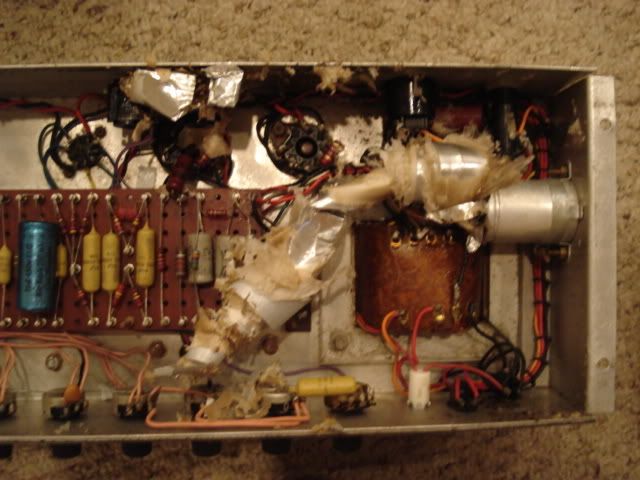
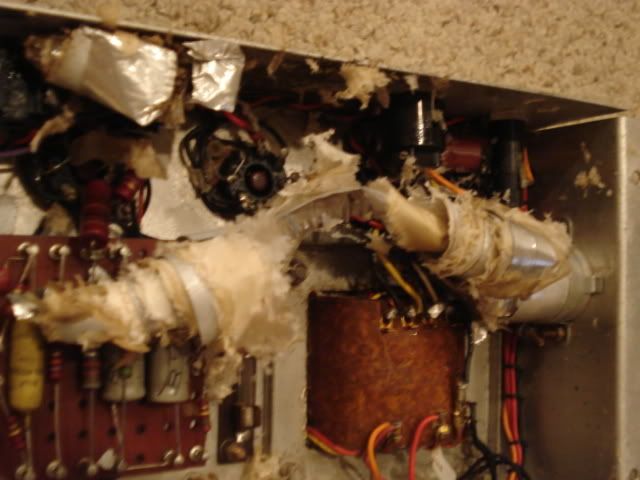
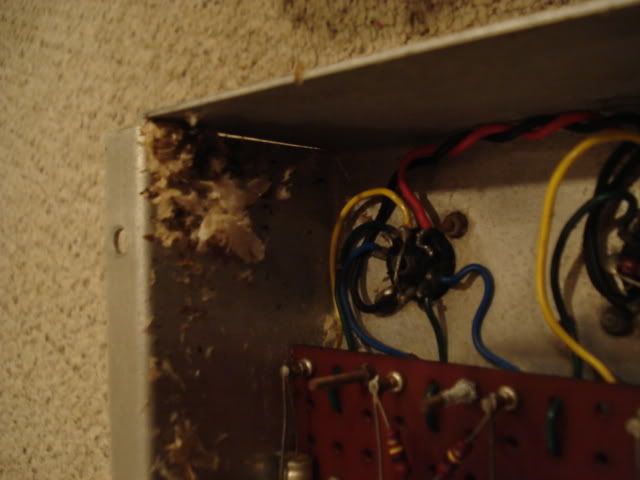
I like to post these pictures whenever there is a discussion about replacing old E caps.
Sure this is an extreme example but it can happen.
Why risk screwing up the amp?
And with a Montgomery Wards amp are we really talking about a collectible amp here that is worth more unmolested?
[IMG:640:480]http://i23.photobucket.com/albums/b392/ ... C01890.jpg[/img]
[IMG:640:480]http://i23.photobucket.com/albums/b392/ ... C01892.jpg[/img]
[IMG:640:480]http://i23.photobucket.com/albums/b392/ ... C01889.jpg[/img]
Sure this is an extreme example but it can happen.
Why risk screwing up the amp?
And with a Montgomery Wards amp are we really talking about a collectible amp here that is worth more unmolested?
[IMG:640:480]http://i23.photobucket.com/albums/b392/ ... C01890.jpg[/img]
[IMG:640:480]http://i23.photobucket.com/albums/b392/ ... C01892.jpg[/img]
[IMG:640:480]http://i23.photobucket.com/albums/b392/ ... C01889.jpg[/img]
Tom
Don't let that smoke out!
Don't let that smoke out!
-
guitardude57
- Posts: 355
- Joined: Fri May 15, 2009 6:19 pm
- Location: Austin, TX
- Contact:
Re: Is this amp "redplating"?
Hmmmmmmm....... I've seen that before.
Mike
I am never surprised and always amazed
I am never surprised and always amazed