
Hi everyone
I've come into the possession of a Hammond ao-14-1e amplifier from an M2 organ off of ebay. It's not coming in for two weeks. I'm planning on using it as the foundation for my first guitar amp build. The usable tubes from amp are:
2x 6SJ7's
1x 6SN7GTA
2x 6V6's
1x 5U4GB
Schematic for the original amp:
There were two other tubes (a 6SC7 and a 6BA6) that are not functioning and the original schematic has a lot going on, so I figured it would be best to do a complete rebuild. I've begun drafting up a schematic. The signal path I'm thinking is just 1 6SJ7 for preamp, then a 6SN7 LTP PI, straight into the 6V6 PP output stage. I'm very much a newbie in this field, so I'd appreciate some guidance. I still need to figure out the specifics of the power supply section (the voltages are really just guesses), but I figure that will be easier when I have it in front of me and can take measurements and make adjustments. For now I'd like to focus on the general layout and biasing. Essentially, is this design feasible for a simple bedside amp?
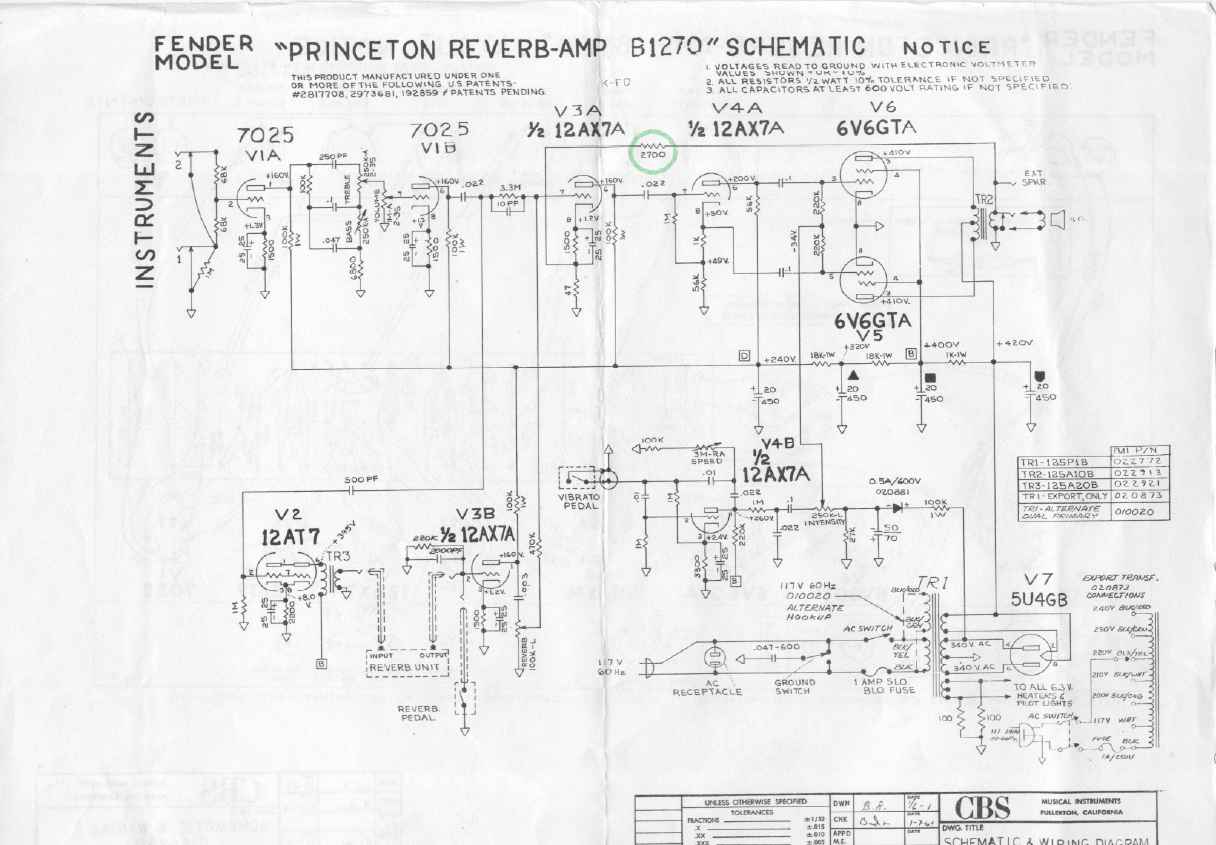
Many of the resistor and cap values have been pieced together from various other amps (Gibson GA 20, Route 6V6 Amp, Princeton Reverb B1270, etc.) and a few forums and articles. For the tone stack I simply plugged in the moonlight tone control. Just looking for someone with more experience and expertise to let me know if I'm at least on the right track here.
Best,
Oli
(I've posted this on another forum, but I've found a lot of helpful info here, so I figured I'd hedge my bets.)
Hammond Organ Amp Conversion
Moderators: pompeiisneaks, Colossal
Hammond Organ Amp Conversion
You do not have the required permissions to view the files attached to this post.
Re: Hammond Organ Amp Conversion
I noticed a couple of things and wanted some input.
First off, and least important, I meant to say the Gibson GA-25, not the GA-20—I linked the right one, whatever.
Second, I've seen people put the fuse right after the on-off switch or on the other line (hot vs neutral). Is there any difference/reason to orient them in one way over the other?
Third, since I have an extra 6SJ7 that would fit into the board, I figured I might as well do something with it. Here were my two thoughts:
1. Just use it as a second input and have a second channel, just like the first that joins at the tone stack. Or maybe give it its own volume knob, not sure.
2. Bias-shifting tremolo circuit like in the Silvertone 1333.
3. Use it for an overdrive stompbox or something like that. I haven't really looked into this one that much, but it could be interesting.
Any other ideas on how I might be able to put it to use?
First off, and least important, I meant to say the Gibson GA-25, not the GA-20—I linked the right one, whatever.
Second, I've seen people put the fuse right after the on-off switch or on the other line (hot vs neutral). Is there any difference/reason to orient them in one way over the other?
Third, since I have an extra 6SJ7 that would fit into the board, I figured I might as well do something with it. Here were my two thoughts:
1. Just use it as a second input and have a second channel, just like the first that joins at the tone stack. Or maybe give it its own volume knob, not sure.
2. Bias-shifting tremolo circuit like in the Silvertone 1333.
3. Use it for an overdrive stompbox or something like that. I haven't really looked into this one that much, but it could be interesting.
Any other ideas on how I might be able to put it to use?



Re: Hammond Organ Amp Conversion
The Gibson amps from any given era are typically very similar. I built a single channel 6SJ7 based on the GA-20. I had to fiddle with the r/c values on that tube until I got it to sound decent to my ears. I remember working towards higher plate voltage on the B+ supply. I'm not going to comment too much on the schematic because I'm not expert enough for that. I suggest at the point where you wrote "+300V" to add another filter cap. If you are using 20uf near the input, that's what I'd use at that spot, too.
Regarding the fuse, there is little point to fusing the neutral. Always fuse the line or hot leg of the a/c supply. Since I can't see your fuse holder I can't tell you exactly how to wire it -- they vary some from brand to brand. Wire it so that when you open the fuse cap, the fuse breaks contact with the a/c line/hot supply and the exposed end is not carrying the line supply. In other words, you don't want to risk a shock from the line supply because the exposed end of the fuse is still hot. Someone may say I'm too fussy about this. Wait until you graze a live a/c line with your hand or arm.
To belabor this point, on some fuse holders, the cap grips the fuse so that opening the cap and pulling removes the fuse. On that type the lug at the bottom of the fuse holder body gets the hot wire and you never touch the fuse with your hand. On others where the cap doesn't grip the fuse, usually the hot goes to the side lug, because the cap, when installed, completes the hot wire to the end of the fuse. On the latter type, there is usually a spring that partially ejects the fuse when you open the cap and you grab it to pull it out. You don't know if a fuse is blown until you pull it and inspect it. This is meant for people who forget to unplug from the wall, and that, unfortunately, can be anyone, experienced or not. There is no such thing as too safe.
Oh, the fuse goes in line between the wall supply and the power switch.
Regarding the fuse, there is little point to fusing the neutral. Always fuse the line or hot leg of the a/c supply. Since I can't see your fuse holder I can't tell you exactly how to wire it -- they vary some from brand to brand. Wire it so that when you open the fuse cap, the fuse breaks contact with the a/c line/hot supply and the exposed end is not carrying the line supply. In other words, you don't want to risk a shock from the line supply because the exposed end of the fuse is still hot. Someone may say I'm too fussy about this. Wait until you graze a live a/c line with your hand or arm.
To belabor this point, on some fuse holders, the cap grips the fuse so that opening the cap and pulling removes the fuse. On that type the lug at the bottom of the fuse holder body gets the hot wire and you never touch the fuse with your hand. On others where the cap doesn't grip the fuse, usually the hot goes to the side lug, because the cap, when installed, completes the hot wire to the end of the fuse. On the latter type, there is usually a spring that partially ejects the fuse when you open the cap and you grab it to pull it out. You don't know if a fuse is blown until you pull it and inspect it. This is meant for people who forget to unplug from the wall, and that, unfortunately, can be anyone, experienced or not. There is no such thing as too safe.
Oh, the fuse goes in line between the wall supply and the power switch.