I stumbled over this in a tomb in a chapter on analog computing circuits.
it a paraphase invertor and very nearly a push-pull pair, but the way its dressed, unlike P-P which reduces even order harmonic distortion products,
this one reduces odd order harmonics...
Looked pretty neat as part of a distortion circuit, thought I'd pass it along.
squaring amplifier
Moderators: pompeiisneaks, Colossal
-
Andy Le Blanc
- Posts: 2582
- Joined: Sat Dec 22, 2007 1:16 am
- Location: central Maine
squaring amplifier
lazymaryamps
-
David Root

- Posts: 3540
- Joined: Fri Aug 04, 2006 3:00 pm
- Location: Chilliwack BC
Re: squaring amplifier
Interesting Andy. What's the mechanism? How does it cancel odd order harmonics?

Re: squaring amplifier
Looks very cathodyne to me. What am I missing?
BTW, in my limited experience with a triode power section, the cathodyne is what works best. I built one a few years back and tried the paraphase with poor results, basically no clean headroom at all.
BTW, in my limited experience with a triode power section, the cathodyne is what works best. I built one a few years back and tried the paraphase with poor results, basically no clean headroom at all.
-
Andy Le Blanc
- Posts: 2582
- Joined: Sat Dec 22, 2007 1:16 am
- Location: central Maine
Re: squaring amplifier
the description is that "as a result of its connection, the even-harmonic terms become the important ones"
this is in compared to a a push-pull, look at how the plates are dressed for a single ended output.
It looks to be like a diff amp with a single ended out, but with a shared anode load.
The "square" is a reference to the output being proportional to the "square" of the input.
I'm intrigued any how, it could be fun to push the even order harmonics.
this is in compared to a a push-pull, look at how the plates are dressed for a single ended output.
It looks to be like a diff amp with a single ended out, but with a shared anode load.
The "square" is a reference to the output being proportional to the "square" of the input.
I'm intrigued any how, it could be fun to push the even order harmonics.
lazymaryamps
-
johnnyreece

- Posts: 1072
- Joined: Thu Jan 26, 2012 2:05 am
- Location: New Castle, IN
Re: squaring amplifier
I'm with Phil...it looks like a cathodyne, with a lot of hardware missing between the PI and power tubes.
-
Andy Le Blanc
- Posts: 2582
- Joined: Sat Dec 22, 2007 1:16 am
- Location: central Maine
Re: squaring amplifier
it is driven by an inverter... look at the output of the circuit.
Its from a text book, the diagram is to illustrate the mathematical model in the simplest form.
the closest parallel is a P-P, you can see the shared cathode resistor, but the pair also shares a plate resistor and a single ended Vout.
I was thinking of driving it with a variety of invertors, the quality there looks to certainly effect the signal out, might try sub-ing it for a clipper stage in a high gain rig.
I was thinking maybe also rigging it as a "self-split" stage, simple to try...
Its from a text book, the diagram is to illustrate the mathematical model in the simplest form.
the closest parallel is a P-P, you can see the shared cathode resistor, but the pair also shares a plate resistor and a single ended Vout.
I was thinking of driving it with a variety of invertors, the quality there looks to certainly effect the signal out, might try sub-ing it for a clipper stage in a high gain rig.
I was thinking maybe also rigging it as a "self-split" stage, simple to try...
lazymaryamps
Re: squaring amplifier
Phase inverter feeding two inputs of a shared plate mixer.... I think that's called an "octaver fuzz". It sums the two out-of-phase signals together, creating an octave effect. The effect comes from strongly emphasid 2nd order harmonic, which is caused by such waveform distortion.
This is what Shin-Ei did with bipolar transistors:
[img:945:456]http://www.diystompboxes.com/pedals/Shi ... n_Fuzz.gif[/img]
Note phase inverter feeding two inputs of a shared collector mixer.
This is what Shin-Ei did with bipolar transistors:
[img:945:456]http://www.diystompboxes.com/pedals/Shi ... n_Fuzz.gif[/img]
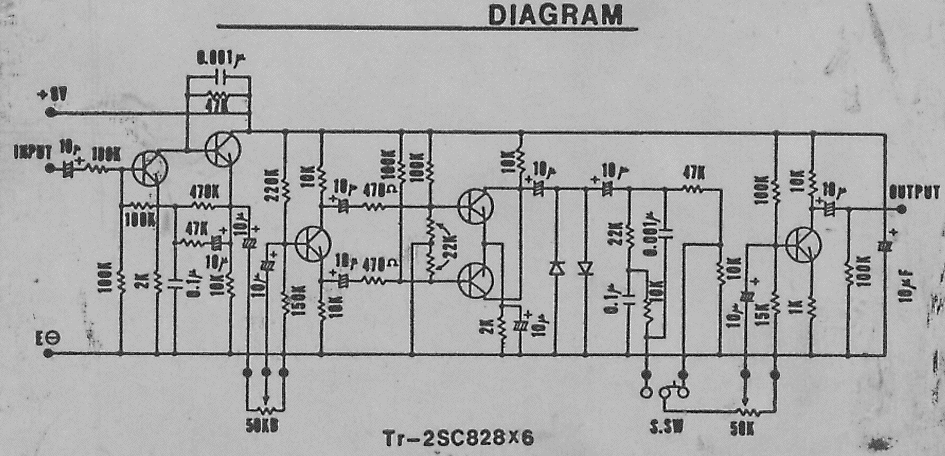
Note phase inverter feeding two inputs of a shared collector mixer.
Re: squaring amplifier
Check out the Laney clip amps....Andy Le Blanc wrote:I stumbled over this in a tomb in a chapter on analog computing circuits.
it a paraphase invertor and very nearly a push-pull pair, but the way its dressed, unlike P-P which reduces even order harmonic distortion products,
this one reduces odd order harmonics...
Looked pretty neat as part of a distortion circuit, thought I'd pass it along.
-
johnnyreece
- Posts: 1072
- Joined: Thu Jan 26, 2012 2:05 am
- Location: New Castle, IN
Re: squaring amplifier
Sorry, I was just quibbling; I agree it's an inverter, but you said it was paraphase, and I was agreeing with Phil that it looked like a cathodyne instead.Andy Le Blanc wrote:it is driven by an inverter... look at the output of the circuit.
Re: squaring amplifier
I'm easily fooled. I see a cathodyne feeding separate grids so I'm thinking PP, but the plates are wired in parallel. That's just strange and I didn't notice first time around. Plates trump grids? I suppose so and that's what makes it paraphase, I guess. I'm ready to let this one go before my head explodes.
Re: squaring amplifier
(deleted)
Last edited by matt h on Fri Mar 27, 2015 4:12 pm, edited 1 time in total.
-
Andy Le Blanc
- Posts: 2582
- Joined: Sat Dec 22, 2007 1:16 am
- Location: central Maine
Re: squaring amplifier
Thank you so much for the octave fuzz scheme,... great to see an application.
That looks like a good candidate to "re-tube". Looks like a practical design for a sand project too.
That looks like a good candidate to "re-tube". Looks like a practical design for a sand project too.
lazymaryamps