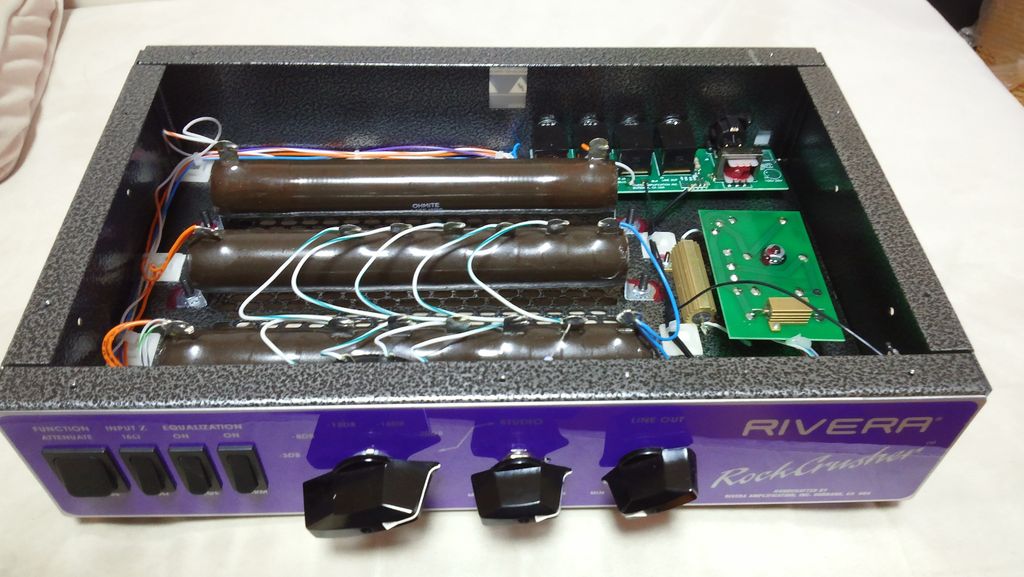
Im trying to understand how they work. What makes them reactive? Mainly im looking inside my Rivera Rockcrusher and see three huge Omite tubular resistors. Two aluminum housed wirewound power resistors that I think are part of the line out feature. I also see a very small transformer maybe the size of a quarter that sits in front of the balanced line out.
Now is all the signal sent through the Omite tubular resistors in a typical reactive attenuator or is it simply splitting the load and the omites are absorbing the power.
Reactive Attenuator. How they work?
Moderators: pompeiisneaks, Colossal
-
JazzGuitarGimp

- Posts: 2357
- Joined: Mon Jul 23, 2012 4:54 pm
- Location: Northern CA
Re: Reactive Attenuator. How they work?
Reactive implies impedance, which is an AC parameter. Resistors behave the same under AC and DC scenarios, and so cannot be thought of as reactive. The transformer, on the other hand, only passes AC signals, and it is reactive because 1) it does not pass DC, and 2) it does not have a flat frequency response. Though a speaker is even more reactive than a transformer because its frequency response vs impedance is very erratic, or all over the map so to speak.
Lou Rossi Designs
Printed Circuit Design & Layout,
and Schematic Capture
Printed Circuit Design & Layout,
and Schematic Capture
-
RockinRocket
- Posts: 652
- Joined: Sun Nov 20, 2011 5:23 am
Re: Reactive Attenuator. How they work?
Well the Rockcrusher is sold as reactive and so is the Bad Cat Unleash. They both appear to be resistor based unless I missed something. It appears the Unleash has a aluminum housed wirewound resistor as its primary (if only) power soak.
Why would it matter? DC is not present after the output transformer.JazzGuitarGimp wrote:Reactive implies impedance, which is an AC parameter. Resistors behave the same under AC and DC scenarios, and so cannot be thought of as reactive.
-
Stevem
- Posts: 5144
- Joined: Fri Jan 24, 2014 3:01 pm
- Location: 1/3rd the way out one of the arms of the Milkyway.
Re: Reactive Attenuator. How they work?
The small transformer you speak of is what makes a balanced signal for that balanced output.
When I die, I want to go like my Grandfather did, peacefully in his sleep.
Not screaming like the passengers in his car!
Cutting out a man's tongue does not mean he’s a liar, but it does show that you fear the truth he might speak about you!
Not screaming like the passengers in his car!
Cutting out a man's tongue does not mean he’s a liar, but it does show that you fear the truth he might speak about you!
-
JazzGuitarGimp
- Posts: 2357
- Joined: Mon Jul 23, 2012 4:54 pm
- Location: Northern CA
Re: Reactive Attenuator. How they work?
This should shed some light on the subject:
http://en.m.wikipedia.org/wiki/Electrical_reactance
http://en.m.wikipedia.org/wiki/Electrical_reactance
Lou Rossi Designs
Printed Circuit Design & Layout,
and Schematic Capture
Printed Circuit Design & Layout,
and Schematic Capture
-
RockinRocket
- Posts: 652
- Joined: Sun Nov 20, 2011 5:23 am
Re: Reactive Attenuator. How they work?
So what are some othe reactive attenuators that are transformer based? Iornman is. What about the Alex and Faustine?
-
JazzGuitarGimp
- Posts: 2357
- Joined: Mon Jul 23, 2012 4:54 pm
- Location: Northern CA
Re: Reactive Attenuator. How they work?
Don't know if they still do, but Weber used to make one based around their Silent Speaker, which is a 6" speaker with no cone.
Lou Rossi Designs
Printed Circuit Design & Layout,
and Schematic Capture
Printed Circuit Design & Layout,
and Schematic Capture
Re: Reactive Attenuator. How they work?
Yes, I bought a Weber "Mass 50" about 15 years ago. Here's the scoop:JazzGuitarGimp wrote:Don't know if they still do, but Weber used to make one based around their Silent Speaker, which is a 6" speaker with no cone.
http://www.tedweber.com/atten.htm
It acts like a speaker because it is one.


Re: Reactive Attenuator. How they work?
From that description it sounds like your attenuator is NOT reactive, it is just resistive.RockinRocket wrote:Im trying to understand how they work. What makes them reactive? Mainly im looking inside my Rivera Rockcrusher and see three huge Omite tubular resistors. Two aluminum housed wirewound power resistors that I think are part of the line out feature. I also see a very small transformer maybe the size of a quarter that sits in front of the balanced line out.
A reactive attenuator would normally attempt to mimic the impedance response of a real loudspeaker, using resistors, inductors and capacitors (or an actual speaker motor but with no cone attached). Doesn't your unit have any inductors and capacitors inside?
(The little transformer will simply be for providing a floating, balanced output, and is too tiny to have any significant reactive effects).
EDIT: Apparently the Rockcrusher is reactive:
"The inductive-reactive network uses high-voltage Japanese film capacitors and a special inductor wound exclusively for us, along with military-grade wire-wound resistors housed in aluminium heatsinks. "
I'm guessing the inductor is hidden under the PCB on the right, fixed with that bit nut.
[img
 577]http://blog-imgs-43-origin.fc2.com/c/a/ ... n/RAN3.jpg[/img]
-
RockinRocket
- Posts: 652
- Joined: Sun Nov 20, 2011 5:23 am
Re: Reactive Attenuator. How they work?
Thank you all for the info and links folks. When reactive attenuators are engaged is all the audio signal sent to the inductors or transformer? If so, why cant the signal be split? While the split signal would go to a reactive load and the other half would be seny to the speaker. Make any sense?

Re: Reactive Attenuator. How they work?
The bad cat unleash is a re-amplifier that can be used as an attenuator, or a booster...so it's a different animal altogether
Re: Reactive Attenuator. How they work?
Do you mean could you divert a small amount of power to the speaker for low volume, and burn the rest silently in the attenuator? It could be done. But it would be tricky to ensure the amplifier always "thinks" that it is driving a normal speaker, and for the speaker to "think" that it is being driven by the amp alone with nothing else in circuit. This would probably mean settling for a compromise where the tone would be somewhat different depending on whether you were using the speaker alone, the attenuator alone, or both together.RockinRocket wrote:Thank you all for the info and links folks. When reactive attenuators are engaged is all the audio signal sent to the inductors or transformer? If so, why cant the signal be split? While the split signal would go to a reactive load and the other half would be seny to the speaker. Make any sense?
-
RockinRocket
- Posts: 652
- Joined: Sun Nov 20, 2011 5:23 am
Re: Reactive Attenuator. How they work?
Yes exactly Merlin. Lets say the amp has two speaker outs for the same ohms. Simply send one out to a reactive load and the other straight to the speaker. Now incorporate that philosophy into a attenuator where it will make all the signal splits with every step on the knob. I suppose it would probably get costly doing it this way. But if it works does it not sound like it would be the most transparent unintrusive way to drop dbs?
-
Reeltarded

- Posts: 10189
- Joined: Sat Feb 14, 2009 4:38 am
- Location: GA USA
Re: Reactive Attenuator. How they work?
Palmer PGA-04 and external power. Done. Amazing even.
Signatures have a 255 character limit that I could abuse, but I am not Cecil B. DeMille.