Hello,
I'm thinking of adding a switch for switching between cathode/fixed bias in my 4x6v6 amp. This is how Kevin O'Conners does it:
[img:600:520]http://www.londonpower.com/GRAPHICS/pwr-fig3.gif[/img]
He writes: Here, a very large resistance - typically 150k - protects the bias supply diode and source winding from excessive dissipation when the bias supply is shunted to ground.
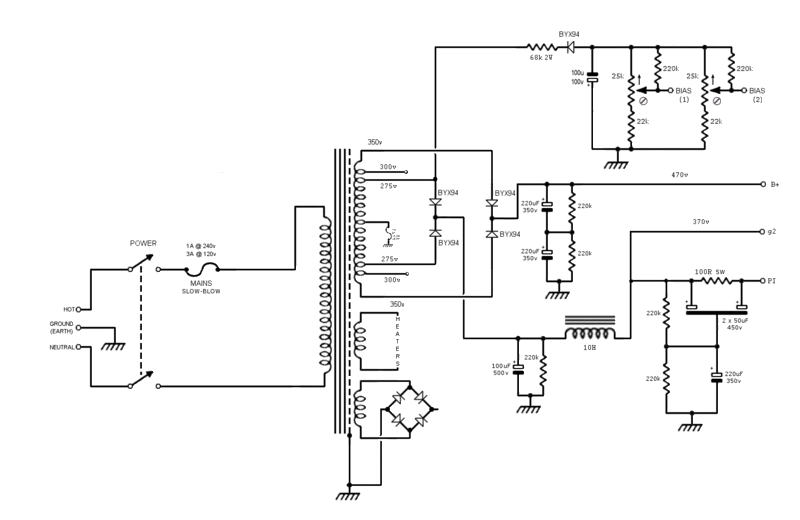
This is my power section now:
[IMG:800:520]http://i94.photobucket.com/albums/l96/s ... M401PS.gif[/img]
My bias solution is a bit different. My dropping resistor is only 68k and is located before the diode as opposed to after as in KOC's. Can I shunt to ground directly after the diode or will I burn the resistor/diode/PT?
Thanks!
Switching between cathode/fixed bias
Moderators: pompeiisneaks, Colossal
-
Hellhammer
- Posts: 70
- Joined: Wed Aug 04, 2010 7:16 am
Switching between cathode/fixed bias

/Stewart
-
Hellhammer
- Posts: 70
- Joined: Wed Aug 04, 2010 7:16 am
Re: Switching between cathode/fixed bias
Hmm no-one? I guess I'll just have to try it out. I might move the dropping resistor after the diode and maybe I can increase its value a bit.
/Stewart
Re: Switching between cathode/fixed bias
I can see how it'll work but I think I'd still use a DPDT and switch the grid bias source between bias voltage and ground, and the cathode between ground and cathode resistor/cap anyway.
Re: Switching between cathode/fixed bias
Or, you could do the math on it and know for sure. E/I=R
-
Hellhammer
- Posts: 70
- Joined: Wed Aug 04, 2010 7:16 am
Re: Switching between cathode/fixed bias
Well of course I could do the math, I just didn't know how to apply it with the dropping resistor on the ac side of the diode. So I moved it efter the diode and upped the resistance to 90k. I now have at most 230V before the dropping resistor. Now correct me if my math is off:
230/90000=0.00255...
2.5mA isn't going to stress the PT..
Using the effect law P=U*I i get:
0.00255*230=0.587
A 2W resistor is enough.
Am I correct?
230/90000=0.00255...
2.5mA isn't going to stress the PT..
Using the effect law P=U*I i get:
0.00255*230=0.587
A 2W resistor is enough.
Am I correct?
/Stewart
Re: Switching between cathode/fixed bias
Yep.Hellhammer wrote:Well of course I could do the math, I just didn't know how to apply it with the dropping resistor on the ac side of the diode. So I moved it efter the diode and upped the resistance to 90k. I now have at most 230V before the dropping resistor. Now correct me if my math is off:
230/90000=0.00255...
2.5mA isn't going to stress the PT..
Using the effect law P=U*I i get:
0.00255*230=0.587
A 2W resistor is enough.
Am I correct?
-
Hellhammer
- Posts: 70
- Joined: Wed Aug 04, 2010 7:16 am
-
Super_Reverb

- Posts: 188
- Joined: Tue Dec 21, 2010 6:28 am
- Location: Indianapolis, USA
Re: Switching between cathode/fixed bias
A point for clarity:Hellhammer wrote:Well of course I could do the math, I just didn't know how to apply it with the dropping resistor on the ac side of the diode.
The bias diode conducts current into your bias circuit on the negative phase of the AC cycle. Current is determined by instantaneous negative AC voltage from secondary, diode voltage drop, and effective series resistance between PT secondary and ground.
On the positive half cycle of 60Hz, the diode does not conduct current.
So, the conclusion is - it doesn't matter where the resistor is in relation to the diode, current through the series combination of resistor and diode is determined by the three terms above.
In other words, (Vsec - Vdiode)/R=I
cheers,
rob
-
Hellhammer
- Posts: 70
- Joined: Wed Aug 04, 2010 7:16 am
Re: Switching between cathode/fixed bias
Good to know. Thanks!
Super_Reverb wrote:A point for clarity:Hellhammer wrote:Well of course I could do the math, I just didn't know how to apply it with the dropping resistor on the ac side of the diode.
The bias diode conducts current into your bias circuit on the negative phase of the AC cycle. Current is determined by instantaneous negative AC voltage from secondary, diode voltage drop, and effective series resistance between PT secondary and ground.
On the positive half cycle of 60Hz, the diode does not conduct current.
So, the conclusion is - it doesn't matter where the resistor is in relation to the diode, current through the series combination of resistor and diode is determined by the three terms above.
In other words, (Vsec - Vdiode)/R=I
cheers,
rob
/Stewart