Yea i did see that thread. I'll make my way through it now that this one is in place.
I put the cathodes of 2 and 3 on a dpdt so I could simultaneously switch them. Very nice. Hard to describe but there seems more depth to the tone and a bit smoother. If this was a straight up 4 stager I'd switch them permanently, but unfortunately it throws off a couple of the other "modes". I'll keep the switch, though. It's on the MV pot so it doesn't seem like another switch thanks again.
Glad you dig the name, Meat I'll try and get some clips up soon
I've tweaked a cascaded preamp forever trying everything you can possibly imagine in every combination. One thing i came to realize is without peakers forget it. I'd find removing one or even all at times i thought sounded good. But in time i'd feel the amp isn't right and in a mix it's lost. No matter what i did i found it's just never right w/o them. Thats MY finding anyways, and for me personally it's now a hard fast rule. Doesn't matter how small the couplers are or anything else. W/O peakers a OD preamp just never works right. Lows are never tight enough and it never cuts in a mix right. But like many things in this game it takes years of tweaking/listening to learn something that becomes a hard fast rule to you. I now never even think about not having them. If i do it never ever fails....after a while i realize it's just no right. Marshall really got that one right IMO.
You're making a generalization based on tweaking your specific amp, but that doesn't mean it's true for all high gain amps. Engls don't have any peakers and they are heavy as hell. Orange's Rockerverb is another example. Just sayin.
Sorry to interfere with your discussion, but what do you mean by 'peaker',
is it a small cap across a plate resistor for instance!?
Your answer will be very helpful gents
If we analyse the frequancy shape only, the combo 2k7//680n on two cathodes create a quite strong difference in gain between unbypassed (lowest) and bypassed (mid to high) frequencies.
Too many peakers together with that kind of bypassed cathodes can create a too trebly sound, specially with single coils.
Of course the effect of the peaker is different, also on the gain stage itself, as changes the output impedance depending on the frequency. This changes the way the stage reacts when overloaded.
If we analyse the frequancy shape only, the combo 2k7//680n on two cathodes create a quite strong difference in gain between unbypassed (lowest) and bypassed (mid to high) frequencies.
Too many peakers together with that kind of bypassed cathodes can create a too trebly sound, specially with single coils.
Of course the effect of the peaker is different, also on the gain stage itself, as changes the output impedance depending on the frequency. This changes the way the stage reacts when overloaded.
And that's even more interesting because both the aforementioned Engls and Rockerverb have no treble peaking and fully bypassed cathodes for most of their stages.
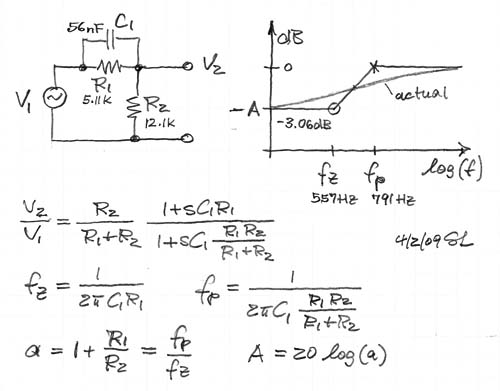
If I may ask a question, what is the equation for a peaker? How do you determine the Q and the frequency? What would the Q and frequency be for a peaker with the r/r/c values of 220k/220k/.001uF?
Thank you for posting these formulae. I have two questions, please:
1. In the first equation, how are the two fractions related? Should there be an = sign between the two (I am thinking probably no)?
2. What does "s" represent in the first equation?
 thanks again.
 I'll try and get some clips up soon