Here you can find a PTP guide
http://www.wattkins.com/node/18030
register (for free) here http://www.wattkins.com/user/register
and you have access to read the thread about PTP
Kagliostro
Point-to-point wiring order
Moderators: pompeiisneaks, Colossal
-
Kagliostro

- Posts: 549
- Joined: Wed Dec 30, 2009 12:09 am
- Location: Italy

Re: Point-to-point wiring order
Kaligroso, I have to speak up, please do not be offended, but that video shows using solder as glue. That gets me really agitated. Why bother with all this work if you cannot even make a decent solder joint?
It was mentioned earlier in this thread when it may be OK to do that - like when you are tweaking and need to get components in and out quick. But just poking a wire at, or through a lug, and then melting solder over it is not cool. You might as well stick plastic model aeroplanes together and hang them from your ceiling instead.
Tin both wire and lug first, wrap the wire or lead around to fix the component in place and then lightly finish the joint with a minimum of solder. Play loud.
Best, tony
-
Cliff Schecht
- Posts: 2629
- Joined: Wed Dec 30, 2009 7:32 am
- Location: Austin
- Contact:
Re: Point-to-point wiring order
Tony I disagree. I actually hate it when people wrap the wires around the socket in such a way that you can't get them out. This makes repairs painful instead of easy, especially if the entire socket needs to be replaced.overtone wrote:Kaligroso, I have to speak up, please do not be offended, but that video shows using solder as glue. That gets me really agitated. Why bother with all this work if you cannot even make a decent solder joint?
It was mentioned earlier in this thread when it may be OK to do that - like when you are tweaking and need to get components in and out quick. But just poking a wire at, or through a lug, and then melting solder over it is not cool. You might as well stick plastic model aeroplanes together and hang them from your ceiling instead.
Tin both wire and lug first, wrap the wire or lead around to fix the component in place and then lightly finish the joint with a minimum of solder. Play loud.
Best, tony
What I do make sure of is that the wire or component lead will sit naturally in the position I want it to without any tension. If there is no tension on the wire then it won't move when soldered in. I noticed the guy in the video does the same thing, his wires sit in the holes without solder. The solder immobilizes the wire and if done right, it should be a strong enough joint to hold the wire in place. His solder joints are nice and shiny meaning they won't be letting go of the wire.
None of my unwrapped solder joints have broken free in any of my practice or gigging amps. I use a healthy amount of solder but not enough to form big blobs, just enough to securely surround the part and the socket hole so everything is immobilized.
Cliff Schecht - Circuit P.I.
-
Kagliostro
- Posts: 549
- Joined: Wed Dec 30, 2009 12:09 am
- Location: Italy
Re: Point-to-point wiring order
Hi Cliff Schecht
As I can understand you are an experienced person about this kind of job
may be also you can learn something here
http://www.hq.nasa.gov/office/codeq/doc ... 93-Ch5.pdf
or beter here
http://ebookbrowse.com/gdoc.php?id=2840 ... 30d68a6b5d
Sometimes people do the job in a way that is adequate to the use, this don't mean that they doesn't know better methods to do things
Kagliostro
As I can understand you are an experienced person about this kind of job
may be also you can learn something here
http://www.hq.nasa.gov/office/codeq/doc ... 93-Ch5.pdf
or beter here
http://ebookbrowse.com/gdoc.php?id=2840 ... 30d68a6b5d
Cancelled don't mean that it is not a reliable methodThis NASA Standard has been cancelled.
Note: Cancelled or Superseded standards
may remain valid on contracts after the date of
the standard’s cancellation or supersession.
Always check the contract to determine the
applicability of a specific standard.
Sometimes people do the job in a way that is adequate to the use, this don't mean that they doesn't know better methods to do things
Kagliostro

Re: Point-to-point wiring order
Amateur builder here....I watched that video of the 18W build. It was fun to watch him work and he showed some nice technique in lead dress and soldering. However, I was shocked to see, I don't think he made any mechanical wiring connections. He just threaded the wire through and soldered it. Not even a slight bend or hook. Everything I've read and seen says you need to make a good mechanical connection. That doesn't mean you wrap it so it can't be undone. Basically, you need to make a "U" shaped bend (or even just an "L" shaped bend) and maybe squeeze it together some before you solder. I've never had difficulty undoing this type of connection. I think that man should be ashamed that he showed people a how to video using solder as "glue".

Re: Point-to-point wiring order
I especially like where NASA does not permit the use of Lead Free solder.
I actually learned something in the NASA doc too. I have had some minor occasional problem with a bad looking joint. Now I see it is Overheated. It usually only happened when reworkng a joint. So now I will turn the heat down a bit.
I see they only require a half a turn around a splice or turret lug too.
I actually learned something in the NASA doc too. I have had some minor occasional problem with a bad looking joint. Now I see it is Overheated. It usually only happened when reworkng a joint. So now I will turn the heat down a bit.
I see they only require a half a turn around a splice or turret lug too.

Re: Point-to-point wiring order
diagrammatiks, that's is a nice way to get the filter caps close to the stage. I will steal it in the future.
I too have started using solder as glue despite what I was taught especially when using NOS parts I'd like to reuse if I have to pull them. On the PI I've learned that if you make your connections too proper you can wind up trashing the whole thing to replace one resistor or cap. I usually do an L bend now though I don't see that being any better than just sitting there straight in. Like Cliff I've never had a problem, but if I was selling amps I'd make sure I had a mechanical connection before soldering.
I too have started using solder as glue despite what I was taught especially when using NOS parts I'd like to reuse if I have to pull them. On the PI I've learned that if you make your connections too proper you can wind up trashing the whole thing to replace one resistor or cap. I usually do an L bend now though I don't see that being any better than just sitting there straight in. Like Cliff I've never had a problem, but if I was selling amps I'd make sure I had a mechanical connection before soldering.
You do not have the required permissions to view the files attached to this post.
-
diagrammatiks
- Posts: 558
- Joined: Sun Mar 27, 2011 12:28 am
Re: Point-to-point wiring order
you should always have a mechanical connection. how much of one is the issue.
nasa went from full wrap during wire wrap standards to a simple 90 degree turn radius at the point of contact with the terminal.
it is a compromise between mechanical stability and repairability.
[img:206:220]http://workmanship.nasa.gov/lib/insp/2% ... 613-01.gif[/img]
solder isn't glue.
also RP here's the finished amp from the other side.
[IMG 764]http://i625.photobucket.com/albums/tt33 ... 339d84.jpg[/img]
nasa went from full wrap during wire wrap standards to a simple 90 degree turn radius at the point of contact with the terminal.
it is a compromise between mechanical stability and repairability.
[img:206:220]http://workmanship.nasa.gov/lib/insp/2% ... 613-01.gif[/img]
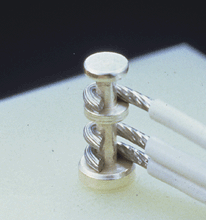
solder isn't glue.
also RP here's the finished amp from the other side.
[IMG
 764]http://i625.photobucket.com/albums/tt33 ... 339d84.jpg[/img]
Re: Point-to-point wiring order
OK, so solder "isn't glue" - but it does have to bond with both surfaces and it does have mechanical strength. Don't think that you can rely on your half-turn to have any strength if you have a contaminated surface that doesn't properly wet.
No, solder is not glue - if it were, it wouldn't be called solder.
No, solder is not glue - if it were, it wouldn't be called solder.
-
diagrammatiks
- Posts: 558
- Joined: Sun Mar 27, 2011 12:28 am
Re: Point-to-point wiring order
it's not about strength.
it's so the component doesn't fall right off in the case that the solder joint cracks. It also guarantees that the electrical connection exists first between the component and the terminal.
The actual connection at the terminal is just 1 actually really insignificant component of the complete mechanical stability standards.
it's so the component doesn't fall right off in the case that the solder joint cracks. It also guarantees that the electrical connection exists first between the component and the terminal.
The actual connection at the terminal is just 1 actually really insignificant component of the complete mechanical stability standards.
Re: Point-to-point wiring order
This is what I was taught. First you have a solid mechanical connection, the solder is there to benefit the connection and to prevent movement and oxidation. But this might also go back to antiquity when parts were big, heavy, and chunky. Maybe in 2012 the glue way works fine if you have attentive soldering skills. Like I said I'm hesitantly moving away from the solid mechanical connection in my own ptp projects simply from the PITA factor, though I fear the dreaded intermittent.diagrammatiks wrote:it's not about strength.
it's so the component doesn't fall right off in the case that the solder joint cracks. It also guarantees that the electrical connection exists first between the component and the terminal.
The actual connection at the terminal is just 1 actually really insignificant component of the complete mechanical stability standards.
-
Cliff Schecht
- Posts: 2629
- Joined: Wed Dec 30, 2009 7:32 am
- Location: Austin
- Contact:
Re: Point-to-point wiring order
Billy, this is not just a heat issue. I run my iron at 800 degrees pretty much all of the time. When I have joints that are coming out brittle, I usually add some flux or a touch more solder (which has flux in it) to reflow the joint. If you are quick and finish soldering before you burn off the flux, it should be able to properly wet the work and get everything to flow smoothly. Might I ask what heat you are running at that gives you issues?billyz wrote:I especially like where NASA does not permit the use of Lead Free solder.
I actually learned something in the NASA doc too. I have had some minor occasional problem with a bad looking joint. Now I see it is Overheated. It usually only happened when reworkng a joint. So now I will turn the heat down a bit.
I see they only require a half a turn around a splice or turret lug too.
Kaligstro: As far as wrapping the wires, it's definitely not something I'm opposed to. I do it on turrets to ensure a solid mechanical connection. But I have some split end turrets that fit parts nicely without needing to wrap anything and I'm yet to have these connections fail. Same with eyelets, I don't bend the parts past the 90 degrees needed to fit the part in the eyelets and once I fill the eyelets up with solder, the parts don't move. If you are doing it right then bending the parts is unnecessary. I'm not sending my amps to space so I don't need to follow NASA's guidelines so much
 .
.FWIW I am in no way saying any of you are wrong. I teach students every semester how to solder and teach them how to do proper wire bends and how to secure parts, but there is more than one way to skin a cat. I probably wouldn't show them how to connect things up with solid core wire and no wire wrap on the end but again, it has worked for me so much in the past that I consider it just as acceptable. For heater wiring or anything with stranded wires I do tend to bend the leads to hold the wire still but with the solid core stuff, if the wire is sitting still on its own where I want to solder it then I can get a solid mechanical connection no problem. If the wire keeps pulling itself out of its home then I will bend it though. I worry about these kind of details one joint at a time anyways
 .
.Cliff Schecht - Circuit P.I.
-
martin manning

- Posts: 14308
- Joined: Sun Jul 06, 2008 12:43 am
- Location: 39°06' N 84°30' W
Re: Point-to-point wiring order
In the case of SMD's, solder is basically glue.
-
diagrammatiks
- Posts: 558
- Joined: Sun Mar 27, 2011 12:28 am
Re: Point-to-point wiring order
yes science is confusing and exciting!
the thing with smd is that the solder is supposed to cover the entire leaded portion of the contact.
through hole component standards are still heavily based around wire-wrap and solderless connection methods.
the thing with smd is that the solder is supposed to cover the entire leaded portion of the contact.
through hole component standards are still heavily based around wire-wrap and solderless connection methods.
Re: Point-to-point wiring order
Me too, 800deg always and I move fast. I never knew you could over-cook a joint just the component at the end of it. I hate lead free so solder so much I laid out for 10 rolls of 44 to keep me to my grave.
Here's a lead free solder guide I once saved off the web, kind of a digression but I'll post it here. Can't say how valid it is, as I stay away.
Here's a lead free solder guide I once saved off the web, kind of a digression but I'll post it here. Can't say how valid it is, as I stay away.
You do not have the required permissions to view the files attached to this post.