Screen grids in beam pentodes control the potential gradients across the device idealizing the space charge to suppress the secondary emission of electrons from the plate.
They control the formation of a virtual cathode in the space between the plate and screen.
With all the discussion of the effects of different screen grid resistor values, no one had a good way to measure the screens voltage after a series resistor.
You can't simply read the screens voltage in a dynamic circuit with a meter referenced to ground.
But... you can measure the voltage difference between the plate and screen.
And by using voltage divider instead of a series resistor as a "screen bias supply",
you can control the difference of the voltage between screen and plate,
You can consistently set up the operating conditions of bias and screens voltage in your amp under static conditions.
I took the chance this morning of taking the approach one step further.
I've noticed that there are nearly always different voltage differences between both halves of the push-pull circuit, measured between the plate and screen, even with matched tubes.
I dressed the screens of each power tube with a voltage divider and supplied them through pot. to control the balance of the screen voltage supply between the power tubes.
I first tried to achieve an equal difference between the plate and screen of both sides, simply working to measure an equal voltage difference on both sides of the push-pull circuit, with the screens being negative relative to the plate.
I then tried balancing screens voltage between the push-pull sides by measuring a minimal difference between the screens of each side.
Under the first condition, with an equal voltage difference measured between the plate and screen on each side, the top end of the amp seemed to open up, it seemed to have more harmonics to my ear, and a tighter more defined low end.
Under the second condition with a minimal voltage difference between the screens of each side the amp lost the top end and top end color, seemed more muddy in the low end.
As I went back and forth, I noticed that when setting the voltage difference between plate and screen, that the difference would peak, and at this peak both sides would be in balance.
I also noticed that when both halves of the push-pull circuit had the same difference between the plate and screen, the difference in the screen voltage between both halves also closely correlated to the difference measured between the plates, across the output transformer.
I suspect this was either an imbalance in the OPT, or a difference of plate resistance between the push-pull pair.
I was impressed with the harmonic content, when the amp had an equal difference between the screen and plate on both sides of the P-P circuit.
One more aspect to keep after while setting up an amp.
Balancing the Difference
Moderators: pompeiisneaks, Colossal
-
Andy Le Blanc
- Posts: 2582
- Joined: Sat Dec 22, 2007 1:16 am
- Location: central Maine
Balancing the Difference
lazymaryamps

-
David Root

- Posts: 3540
- Joined: Fri Aug 04, 2006 3:00 pm
- Location: Chilliwack BC
Re: Balancing the Difference
Indeed. Going to have to read that closely a few more times!
How much screen to plate voltage difference to get the nice harmonics?
How much screen to plate voltage difference to get the nice harmonics?
Re: Balancing the Difference
(deleted)
Last edited by matt h on Fri Mar 27, 2015 7:03 am, edited 1 time in total.

Re: Balancing the Difference
Interesting, just to clarify, are you saying that using "matched" pair of tubes, and setting both tubes for equal idle current still results in different Vp-g2? Then may I ask how the tubes were matched? And is this in a fixed biased or cathode biased output stage?Andy Le Blanc wrote:I've noticed that there are nearly always different voltage differences between both halves of the push-pull circuit, measured between the plate and screen, even with matched tubes.

Re: Balancing the Difference
Nice one Andy!
Tubes are matched considering Ip and Gm, usually.
Tubes are matched considering Ip and Gm, usually.
-
Andy Le Blanc
- Posts: 2582
- Joined: Sat Dec 22, 2007 1:16 am
- Location: central Maine
Re: Balancing the Difference
I make it a point to double check the screens at idle on every rig I can.
I've learned over time that there is a very certain correlation between bias (operational point) and design.
Take a look back to some of those old fender CBS designs that have a balance control instead of an adjustable bias, the whole design centers on an operational point.
When you change the bias (operational point), your actually increasing/decreasing the plate voltage relative to the screens... outside of the intended design
Working back thru the posts..
Yes, even matched tubes show different voltages between the plate and screen.
I can't say specifically about the practice of matching by manufacture.
But I have seen this thru all sorts of tube brands.
It's usually not bad, a volt give or take, a few volts, but I have seen it as bad a 10V.
Could be one of the reasons why you experience tube failure,
all the spec's are wonderfully close,
but you cook the tube at your bias point in short order with one of the screens in the pair acting as the positive attract'er
I've seen this irregardless of bias type
My amp is cathode biased, the grids are within 10ma DC, not too bad.
raises a good question, I'll see if the dc balance here affects what I'm measuring at the screens
I was surprised at how the tone of the rig changed, tighter and brighter
and noticeably harmonically colored, I didn't expect that.
The screens landed balanced at 11.58 v below the plates, I don't think this means much, other than the balance, but another step could be to vary this up or down and find where it lands best to your ear.
An imbalance might what you favor as well, shouldn't cast this in stone
I tend to favor the screens around 5v below the plates, closer to the Class A from the data sheet, but I haven't fully explored the AB1/AB2 data points off the tube sheets yet either.
great chance to set up a rig per the conditions off tube sheet and giver a listen
I've learned over time that there is a very certain correlation between bias (operational point) and design.
Take a look back to some of those old fender CBS designs that have a balance control instead of an adjustable bias, the whole design centers on an operational point.
When you change the bias (operational point), your actually increasing/decreasing the plate voltage relative to the screens... outside of the intended design
Working back thru the posts..
Yes, even matched tubes show different voltages between the plate and screen.
I can't say specifically about the practice of matching by manufacture.
But I have seen this thru all sorts of tube brands.
It's usually not bad, a volt give or take, a few volts, but I have seen it as bad a 10V.
Could be one of the reasons why you experience tube failure,
all the spec's are wonderfully close,
but you cook the tube at your bias point in short order with one of the screens in the pair acting as the positive attract'er
I've seen this irregardless of bias type
My amp is cathode biased, the grids are within 10ma DC, not too bad.
raises a good question, I'll see if the dc balance here affects what I'm measuring at the screens
I was surprised at how the tone of the rig changed, tighter and brighter
and noticeably harmonically colored, I didn't expect that.
The screens landed balanced at 11.58 v below the plates, I don't think this means much, other than the balance, but another step could be to vary this up or down and find where it lands best to your ear.
An imbalance might what you favor as well, shouldn't cast this in stone
I tend to favor the screens around 5v below the plates, closer to the Class A from the data sheet, but I haven't fully explored the AB1/AB2 data points off the tube sheets yet either.
great chance to set up a rig per the conditions off tube sheet and giver a listen
lazymaryamps
Re: Balancing the Difference
Do you mean 10mV? In any case, assuming the two tubes are adjusted for the same cathode current, then a few volts difference between the screen voltages is not a big deal, 10V is probably too much.Andy Le Blanc wrote:My amp is cathode biased, the grids are within 10ma DC, not too bad.
raises a good question, I'll see if the dc balance here affects what I'm measuring at the screens
I tend to favor the screens around 5v below the plates, closer to the Class A from the data sheet, but I haven't fully explored the AB1/AB2 data points off the tube sheets yet either.
Thanks for the tip, I will play with the screen voltage divider in my next build to see how it effects the sound.
Re: Balancing the Difference
Interesting stuff Andy. I read this twice already.
Need more coffee before reading a third time - brain's not fully online yet...
Hmmm.
Need more coffee before reading a third time - brain's not fully online yet...
Hmmm.
Why Aye Man

Re: Balancing the Difference
Hi Andy,
do you think a small trim ohm pot (1-200 ohm) between the higher voltage side of the screen R / tube pin would make that? Than I could dial the higher voltage down to the right amount of the other side. Does this work that way?
I would like to test this out. At the moment there are 1k/5W screen resistors in. 2xEL84, cathode bias.
Hans-Jörg
do you think a small trim ohm pot (1-200 ohm) between the higher voltage side of the screen R / tube pin would make that? Than I could dial the higher voltage down to the right amount of the other side. Does this work that way?
I would like to test this out. At the moment there are 1k/5W screen resistors in. 2xEL84, cathode bias.
Hans-Jörg
Re: Balancing the Difference
Hello,
I´m very interested in this thema:
Best
Hans-Jörg
I´m very interested in this thema:
Has anyone a suggestion?hans-jörg wrote:Hi Andy,
do you think a small trim ohm pot (1-200 ohm) between the higher voltage side of the screen R / tube pin would make that? Than I could dial the higher voltage down to the right amount of the other side. Does this work that way?
I would like to test this out. At the moment there are 1k/5W screen resistors in. 2xEL84, cathode bias.
Hans-Jörg
Best
Hans-Jörg
-
Andy Le Blanc
- Posts: 2582
- Joined: Sat Dec 22, 2007 1:16 am
- Location: central Maine
Re: Balancing the Difference
here an old example with screen supplied from a voltage divider...
notice there's no screen grid resistors, this would provide the condition where the screens are tied at the same voltage.
if you add screen grid resistors, the push-pull circuit will self balance and fall to where the tube characteristics naturally allow.
what I tried was to put a pot. before the screen grid resistors to find a balance between the sides of the P-P circuit measured as an equal voltage difference between the plate and screen.
I supplied the screens so that the screens voltage could be tilted between the screens to achieve this.
The screens supply is through the wiper of a pot. or rheostate and then to a bleeder to ground and screen grid resistor, you can put the bleeders before the screen grid resistors at the ends of the pot. or after the screen grid resistors right on the tube socket.
keep in mind that I this case you are using "bleeders" and not a tradition resistance divider, this allows you to get away with a lower wattage higher ohmeric value.
A resistor between he bleeders and power supply effectively become a "set" resistor, I put a pot. here to balance between both sides of the P-P circuit.
I think it may be more useful this way, you won't know which way the balance might go.
I found what might be a useful mod out of this. simply put a switch between the screens to tie together the screens voltage after the screen grid resistors, the tone changes.
notice there's no screen grid resistors, this would provide the condition where the screens are tied at the same voltage.
if you add screen grid resistors, the push-pull circuit will self balance and fall to where the tube characteristics naturally allow.
what I tried was to put a pot. before the screen grid resistors to find a balance between the sides of the P-P circuit measured as an equal voltage difference between the plate and screen.
I supplied the screens so that the screens voltage could be tilted between the screens to achieve this.
The screens supply is through the wiper of a pot. or rheostate and then to a bleeder to ground and screen grid resistor, you can put the bleeders before the screen grid resistors at the ends of the pot. or after the screen grid resistors right on the tube socket.
keep in mind that I this case you are using "bleeders" and not a tradition resistance divider, this allows you to get away with a lower wattage higher ohmeric value.
A resistor between he bleeders and power supply effectively become a "set" resistor, I put a pot. here to balance between both sides of the P-P circuit.
I think it may be more useful this way, you won't know which way the balance might go.
I found what might be a useful mod out of this. simply put a switch between the screens to tie together the screens voltage after the screen grid resistors, the tone changes.
lazymaryamps
Re: Balancing the Difference
This is one of the reasons Jansen amplifiers (NZ brand from the 1960 and 70s) went to a separate secondary winding supply for the screens, i.e. to stiffen the screen supply and enhance tube life.Andy Le Blanc wrote:Yes, even matched tubes show different voltages between the plate and screen.
I can't say specifically about the practice of matching by manufacture.
But I have seen this thru all sorts of tube brands.
It's usually not bad, a volt give or take, a few volts, but I have seen it as bad a 10V.
Could be one of the reasons why you experience tube failure,
all the spec's are wonderfully close,
but you cook the tube at your bias point in short order with one of the screens in the pair acting as the positive attract'er
I've seen this irregardless of bias type
You do not have the required permissions to view the files attached to this post.
He who dies with the most tubes... wins
Re: Balancing the Difference
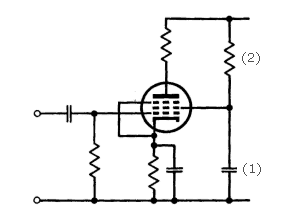
This Crowhust article might be of interest. Basically, to reduce screen grid voltage fluctuation, the bleed current should be made larger than the expected screen grid current. For additional regulation, the screen voltage should be bypassed with a capacitor as well. But all of the above seem to be more suitable for hi-fi applications, not sure how much of them is applicable for guitar amps, since screen grid "compression" is one of the sought after features, e.g., TW Express. For Janzen's bass amp, I could see the rationale for a stiffer screen supply, but for guitar amps, I am not sure... then again, YMMV. 
Re: Balancing the Difference
How about this trick to keep the screen voltage steady?
The cap on the screen is large enough (.1uF) to cover and fluctuations in screen voltage/ current.
http://www.vias.org/crowhurstba/crowhur ... 3_032.html
[img:288:212]http://www.vias.org/crowhurstba/img/cro ... l3-78b.gif[/img]
The cap on the screen is large enough (.1uF) to cover and fluctuations in screen voltage/ current.
http://www.vias.org/crowhurstba/crowhur ... 3_032.html
[img:288:212]http://www.vias.org/crowhurstba/img/cro ... l3-78b.gif[/img]
Tom
Don't let that smoke out!
Don't let that smoke out!