Hi.
I've fallen in love with 5F11 Vibrolux / AA164 Princeton reverb style bias vary tremolo. It uses only one triode and goes from lush and mellow to steep and choppy with very broad speed range.
I was thinking can it be implemented into cathode biased SE amps?
I drew a fast schem. What do you think?
Will it work like it should?
I've seen this type of arrangement in some cathode biased P-P amps, but not in any SE amps. Is it possible to do like that?
-T
Bias tremolo in a SE amp?
Moderators: pompeiisneaks, Colossal
-
Dingleberry
- Posts: 192
- Joined: Tue Jul 13, 2010 8:12 pm
Bias tremolo in a SE amp?
You do not have the required permissions to view the files attached to this post.
Re: Bias tremolo in a SE amp?
This is a guess, but I think the output tube cathode current would adjust enough to cancel the effect. In push-pull, the combined cathodes sit at an average current for the two so trem works because it's trying to pull both tubes more towards cutoff. With one tube, if the cathode sees the grid going more negative (or positive for that matter) it would react to stabilize the current.
Re: Bias tremolo in a SE amp?
A little bit what firestorm said
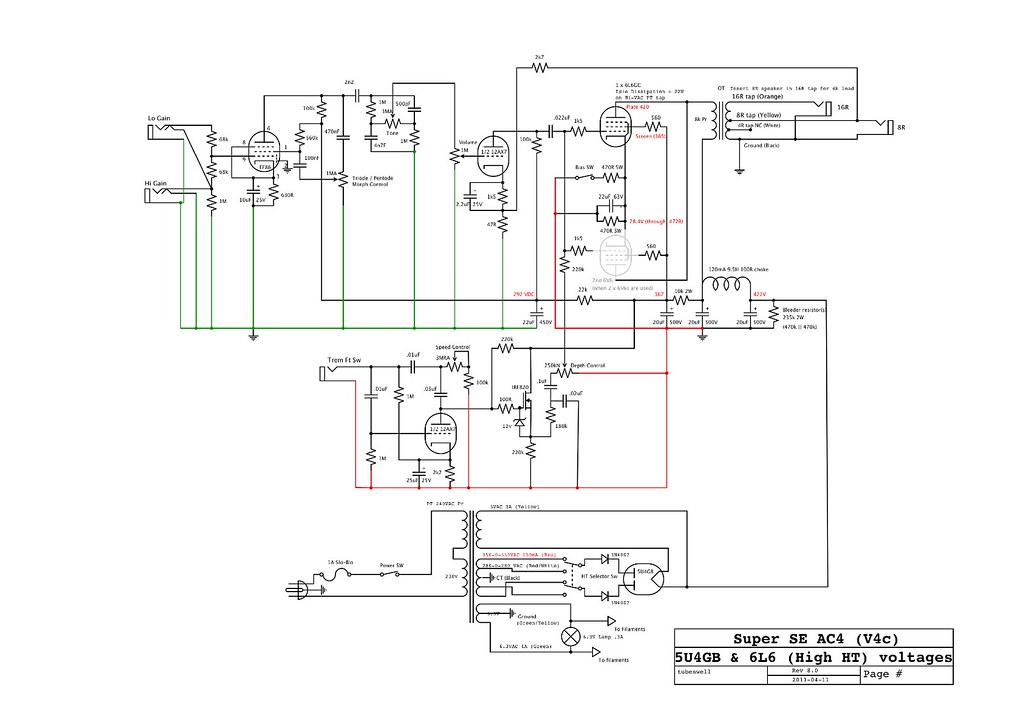
I built an SE amp with bias vary trem last year (or the year before?) and the depth pot didn't kick in until about 1/3 of the dial. This is because the wiggle current is 'fighting' the tube current. However once there is enough current there the effect is quite pleasant.
[img 724]http://farm9.staticflickr.com/8029/8031 ... bd9c_b.jpg[/img]
http://www.nzguitars.com/forum/download ... hp?id=8343
I built an SE amp with bias vary trem last year (or the year before?) and the depth pot didn't kick in until about 1/3 of the dial. This is because the wiggle current is 'fighting' the tube current. However once there is enough current there the effect is quite pleasant.
[img
 724]http://farm9.staticflickr.com/8029/8031 ... bd9c_b.jpg[/img]
http://www.nzguitars.com/forum/download ... hp?id=8343
He who dies with the most tubes... wins
-
Dingleberry
- Posts: 192
- Joined: Tue Jul 13, 2010 8:12 pm
Re: Bias tremolo in a SE amp?
Thank you guys. I knew I wasn't alone. I see that you have a cathode follower and you have connected the depth pot a little differently Tubeswell. The principle is the same though.
It won't be an impossible task to make the pot affect at the first 1/3 of the travel. Also after a bit more googling I found out that Canadians did it already. Check out Garnet Gnome schematics. Basically the same schem that I drew. And one popped into my mind when I saw your schem. People use fets as a cathode follower so why couldn't you use one as an oscillator too? If you don't have a spare triode or a whole tube you could easily have tremolo in your amp with one or two fets and just few more components. Anyone tried?
-T
It won't be an impossible task to make the pot affect at the first 1/3 of the travel. Also after a bit more googling I found out that Canadians did it already. Check out Garnet Gnome schematics. Basically the same schem that I drew. And one popped into my mind when I saw your schem. People use fets as a cathode follower so why couldn't you use one as an oscillator too? If you don't have a spare triode or a whole tube you could easily have tremolo in your amp with one or two fets and just few more components. Anyone tried?
-T
-
statorvane

- Posts: 568
- Joined: Thu May 11, 2006 3:28 pm
- Location: Upstate New York
Re: Bias tremolo in a SE amp?
Here's a SE tremolo I adapted from a Kalamazoo amp. It wiggles the power tube input grid, not the bias.
[img656]http://i165.photobucket.com/albums/u76/ ... m_Trem.jpg[/img]
Hope this helps.
[img
656]http://i165.photobucket.com/albums/u76/ ... m_Trem.jpg[/img]Hope this helps.


Re: Bias tremolo in a SE amp?
Very cool design. How does the amp generally sound? Bluesy/chimey? I like the vari-grid method for tremolo. Looks like a super-fast/realtime master volume turnerstatorvane wrote:Here's a SE tremolo I adapted from a Kalamazoo amp. It wiggles the power tube input grid, not the bias.

I think there is a typo on R4. Should be 220k, not 220R

Re: Bias tremolo in a SE amp?
which in effect is wiggling the bias (just sayin')statorvane wrote:Here's a SE tremolo I adapted from a Kalamazoo amp. It wiggles the power tube input grid, not the bias.
He who dies with the most tubes... wins
-
statorvane
- Posts: 568
- Joined: Thu May 11, 2006 3:28 pm
- Location: Upstate New York
Re: Bias tremolo in a SE amp?
Good catch on R4! Yes, 220K to bleed off the filter caps when shut down.
It's just a P1 eX with a tremolo. So yes, sounds just like a P1 eX with someone twiddling the MV knob.
Phil Rowley suggested I increase the volume pot to 2M since the addition of the tremolo signal and pot decreased the impedance at the grid. I was losing a little signal before I did that. Now it's perfect. However, the usual suspects do not often carry 2M audio pots.
It's just a P1 eX with a tremolo. So yes, sounds just like a P1 eX with someone twiddling the MV knob.
Phil Rowley suggested I increase the volume pot to 2M since the addition of the tremolo signal and pot decreased the impedance at the grid. I was losing a little signal before I did that. Now it's perfect. However, the usual suspects do not often carry 2M audio pots.
Re: Bias tremolo in a SE amp?
This arrangement works well for me - the signal from the tremolo is fed to the 'ground' end of the volume pot.
(The green LED and the little caps in the tremolo circuit are to reduce thumping)
Andy
(The green LED and the little caps in the tremolo circuit are to reduce thumping)
Andy
You do not have the required permissions to view the files attached to this post.
Re: Bias tremolo in a SE amp?
This is all interesting. But I'm still thinking that the bias itself cannot change in SE because the cathode current will change in response to the change in voltage at the grid.
Now we know that higher frequencies tend to "ride" lower frequencies (look at Fourier transforms). So what exactly is happening here?
In push-pull, the grids are opposed. But in SE there is only one grid, so there must be some modulation of the grid signal for this to work.
Now we know that higher frequencies tend to "ride" lower frequencies (look at Fourier transforms). So what exactly is happening here?
In push-pull, the grids are opposed. But in SE there is only one grid, so there must be some modulation of the grid signal for this to work.
Re: Bias tremolo in a SE amp?
The bias will wiggle in the output tube if you have enough wiggle current (from the LFO) to overcome the tube current. The bias wiggle is adding more -ve voltage to the output tube grid, causing it to go towards cutoff. That's my take on it anyhowFirestorm wrote:This is all interesting. But I'm still thinking that the bias itself cannot change in SE because the cathode current will change in response to the change in voltage at the grid.
Now we know that higher frequencies tend to "ride" lower frequencies (look at Fourier transforms). So what exactly is happening here?
In push-pull, the grids are opposed. But in SE there is only one grid, so there must be some modulation of the grid signal for this to work.
He who dies with the most tubes... wins
-
martin manning

- Posts: 14308
- Joined: Sun Jul 06, 2008 12:43 am
- Location: 39°06' N 84°30' W
Re: Bias tremolo in a SE amp?
Current will change, but adding an offset from zero to the grid voltage in a cathode biased SE amp (either periodic or fixed) will shift the zero-signal grid-to-cathode voltage, aka bias.Firestorm wrote:This is all interesting. But I'm still thinking that the bias itself cannot change in SE because the cathode current will change in response to the change in voltage at the grid.
You could think of this as superimposing a low frequency signal on top of the guitar signal at the grid of the power tube, but that thinking can be applied equally to a push-pull power section with modulated bias voltage. In both SE and PP cases, the zero-signal grid-to-cathode voltage is being modulated, and so by definition the bias is being modulated.Firestorm wrote:Now we know that higher frequencies tend to "ride" lower frequencies (look at Fourier transforms). So what exactly is happening here?
In push-pull, the grids are opposed. But in SE there is only one grid, so there must be some modulation of the grid signal for this to work.
Re: Bias tremolo in a SE amp?
No wiggle room here, I think.tubeswell wrote:
The bias will wiggle in the output tube if you have enough wiggle current (from the LFO) to overcome the tube current. The bias wiggle is adding more -ve voltage to the output tube grid, causing it to go towards cutoff. That's my take on it anyhow

Put a 10Khz signal in the grid and the cathode will change direction 10,000 times per second. It can't possibly have trouble keeping up with the 2-4 times per second of the LFO.
But if we're actually modulating the grid signal (as suggested earlier), I wonder how much bias modulation we're hearing versus signal modulation. Some of both I suspect. I do know that in a Princeton Reverb (where the bias is fixed/non-adjustable), if the bias supply resistors drift so the amp is running a very hot class A, the trem will mostly stop working (but not completely). The signal is still being modulated by the LFO, but the effect is much smaller.
So what we like (I think) is the sound of both signal and bias being modulated.
This raises some (possibly) interesting ideas wrt phase.
-
martin manning
- Posts: 14308
- Joined: Sun Jul 06, 2008 12:43 am
- Location: 39°06' N 84°30' W
Re: Bias tremolo in a SE amp?
In that condition the LFO signal no longer has enough voltage swing to keep the output tubes in cut-off over part of its cycle, and the class A SE case is similar in that it requires a large p-p voltage. The LFO signal is subsonic, so the percieved effect is modulation of the guitar signal.Firestorm wrote:I do know that in a Princeton Reverb (where the bias is fixed/non-adjustable), if the bias supply resistors drift so the amp is running a very hot class A, the trem will mostly stop working (but not completely). The signal is still being modulated by the LFO, but the effect is much smaller.
Re: Bias tremolo in a SE amp?
Yes, by definition the grid-to-cathode voltage is bias. But ...martin manning wrote:Current will change, but adding an offset from zero to the grid voltage in a cathode biased SE amp (either periodic or fixed) will shift the zero-signal grid-to-cathode voltage, aka bias.Firestorm wrote:This is all interesting. But I'm still thinking that the bias itself cannot change in SE because the cathode current will change in response to the change in voltage at the grid.
Here we disagree (and folks, Martin is smarter than me by a couple of miles) but, in push-pull the LFO signal is being applied equally to opposing sides: the ground reference for both sides is being pulled more negative (typically), so the signal wrt plate output should vary by 2X.martin manning wrote:You could think of this as superimposing a low frequency signal on top of the guitar signal at the grid of the power tube, but that thinking can be applied equally to a push-pull power section with modulated bias voltage. In both SE and PP cases, the zero-signal grid-to-cathode voltage is being modulated, and so by definition the bias is being modulated.Firestorm wrote:Now we know that higher frequencies tend to "ride" lower frequencies (look at Fourier transforms). So what exactly is happening here?
In push-pull, the grids are opposed. But in SE there is only one grid, so there must be some modulation of the grid signal for this to work.
In SE that would have to be 1X (I think).