Hey guys, a little while ago I was looking to build a JCM800, or buy one for cheap.
Instead, I ended up finding a Peavey VTM60, one of Peavey's own "JCM800 killers", for really cheap. Got the fullstack for 300, plus a PA head. Couldn't pass it up.
Anyway, the amp sounds great, just needs a bit of fine tuning. I've done a tiny a bit of modding. I'll cover what I have done, and what I haven't/plan to do.
DONE:
- remove the bright cap, C2
- replace R2 with 220K
- new tubes, used JJ 6L6GCs, and a mix in the preamp, with some Tung Sols, a Mesa, and a Shugang.
PLANNING TO DO:
- replace R9 with a 3.3K resistor, replace R8 with a 50K pot. This is for adjusting the bias. Changing R9 corrects the voltage divider here so we get a more adjustable control.
- replace filter caps. The amp is around 20 years old, still has stock caps. Probably about time to go.
- replace all the 1/4W resistors with metal film resistors, for lower noise.
Questions I have...
- Some people replace R5 with a choke. What value of choke? does this make a significant difference? Or any difference at all?
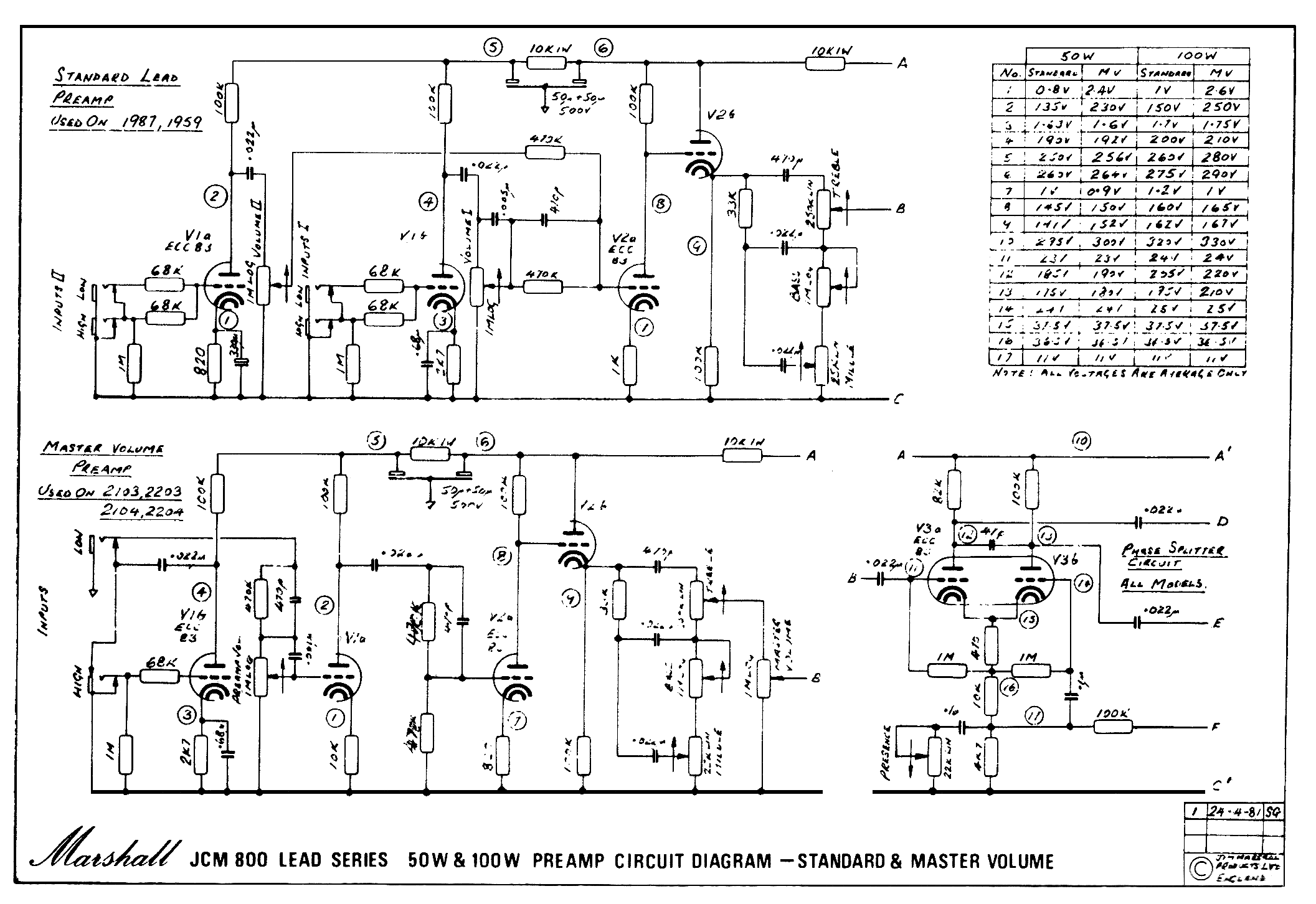
- I was comparing it to the JCM800 schematic, and noticed the same treble peaking circuit at the low gain jack. In JCM800s, a popular mod is to replace the 470pF/470K combo here for a 68K, like the old Super Leads. Am I correct in thinking this? Is this a worthwhile mod? Will it sound good?
- Any other good ideas on mods? I'm not quite set to switch to EL34s, I wanna see the best I can get out of this amp before I do that.
Here are the relevant schematics:
JCM800: http://www.drtube.com/schematics/marshall/jcm800pr.gif
VTM120: http://www.schematicheaven.com/newamps/ ... tm_120.pdf
VTM60 - JCM800
Moderators: pompeiisneaks, Colossal
Re: VTM60 - JCM800
I took the plunge, added the bias mod, went with the Super Lead style 68K resistor in place of the treble peaking circuit, and I also changed the slope resistor in the tonestack to shift the range and make it more meaty.
It's running at about 28mA, I may try and get it hotter.
Definitely pleased with the results. No fizz, sounds fat and thick with my Strat.
I'll be trying a few other things. If anyone knows anything about the choke mod, or any other cool mods, I would be grateful.
It's running at about 28mA, I may try and get it hotter.
Definitely pleased with the results. No fizz, sounds fat and thick with my Strat.
I'll be trying a few other things. If anyone knows anything about the choke mod, or any other cool mods, I would be grateful.

Re: VTM60 - JCM800
Hey dude, wow, good price! You can't go wrong for that.azrael wrote:Hey guys, a little while ago I was looking to build a JCM800, or buy one for cheap.
Instead, I ended up finding a Peavey VTM60, one of Peavey's own "JCM800 killers", for really cheap. Got the fullstack for 300, plus a PA head. Couldn't pass it up.
I'm not sure what your goals are for the amp tonewise... are you trying to make the amp more JCM800-like or go in a different direction?azrael wrote:Anyway, the amp sounds great, just needs a bit of fine tuning. I've done a tiny a bit of modding. I'll cover what I have done, and what I haven't/plan to do.
Already, your amp should be a gain machine and while it shares some DNA with a JCM800, it's quite different. Just looking at some of the values (and the additional gain stage at V3), I'm sure it does the chainsaw thing quite well.
OK, if you removed C2, that is the coupling cap for V1a, you need that guy in there (!). Perhaps you are mistaking C2 for a different cap?azrael wrote:DONE:[/b]
- remove the bright cap, C2
- replace R2 with 220K
- new tubes, used JJ 6L6GCs, and a mix in the preamp, with some Tung Sols, a Mesa, and a Shugang.
Replacing R2 with 220k will add even more gain to the amp. If you are trying to keep it in the JCM realm or move closer, that will move you away. Looking at the schematic, the stock amp has <i>plenty</i> of gain and I would exercise some caution here. So if you crank up the gain even more, you risk introducing some undesirable side effects. It will get ratty and lose some of its articulation. You've got to watch blocking distortion in an amp like this. You might find that it starts sounding flat, loses it's organic warmth and replaces it with a thud and excessive brightness.
With the amp running 6L6s and with the phase inverter as it is, it's got a little more in common with a Boogie than a Marshall but I am guessing they wanted to keep the power section clean(er) with more preamp distortion. Very Boogie-esque.
That will warm bias the tube strongly which would be good following the cold biased previous stage. I would use the pot to find the sweet spot and then replace it with a fixed resistor once you are happy with the tone at that stage.azrael wrote:PLANNING TO DO:
- replace R9 with a 3.3K resistor, replace R8 with a 50K pot. This is for adjusting the bias. Changing R9 corrects the voltage divider here so we get a more adjustable control.
That would be a good idea and alone would probably do a lot to improve the tone. New tubes were a good idea too.azrael wrote:- replace filter caps. The amp is around 20 years old, still has stock caps. Probably about time to go.
- replace all the 1/4W resistors with metal film resistors, for lower noise.
I have heard of folks using a fasel inductor from a wah pedal at that location. I have no experience with that however. I would start with a wah inductor. You could also bias it with an LED or put a pot there. R5 is 10k in a JCM800 and lowering it too much gets it on the chainsaw/buzzy/nasty side. I see that Peavey settled on 6k8. It's obvious they chose what they did for the amp for specific reasons.azrael wrote:Questions I have...
- Some people replace R5 with a choke. What value of choke? does this make a significant difference? Or any difference at all?
Don't take this the wrong way, but I think you are pretty pretty far from Superlead territory with the above mods. I was trying to figure out from your original post if you were trying to make the amp into a JCM800. You could remove the treble peaking circuit as many don't care for it and a JCM800 is plenty bright without it. I have a JCM800 type amp and did not use a resistor there. I did add a 100R grid resistor on the entrance to V1b however to minimize blocking distortion. I also lowered the coupling cap value slightly there as well. I upped the bass cap to 0.047uF. I also bypassed V2a with an 0.68uF film cap.azrael wrote: - I was comparing it to the JCM800 schematic, and noticed the same treble peaking circuit at the low gain jack. In JCM800s, a popular mod is to replace the 470pF/470K combo here for a 68K, like the old Super Leads. Am I correct in thinking this? Is this a worthwhile mod? Will it sound good?
Personally, I think replacing the filter caps (increase them a bit if you are going to play dropped tunings and don't want it to sag much) and changing out a few key resistors (plate loads) with 2W metal or carbon films will do a lot for you. If you are after a true JCM, then I would make it into one. But the amp is a hybrid as it is now and the mods you are adding are making it more so. I'm not trying to nay-say your efforts, just pointing that out, that's allazrael wrote:- Any other good ideas on mods? I'm not quite set to switch to EL34s, I wanna see the best I can get out of this amp before I do that.

Let us know how it goes!
Re: VTM60 - JCM800
thanks! it was totally worth it!Colossal wrote:Hey dude, wow, good price! You can't go wrong for that.
Definitely going more JCM800 like.Colossal wrote:I'm not sure what your goals are for the amp tonewise... are you trying to make the amp more JCM800-like or go in a different direction?
Already, your amp should be a gain machine and while it shares some DNA with a JCM800, it's quite different. Just looking at some of the values (and the additional gain stage at V3), I'm sure it does the chainsaw thing quite well.
I don't use the extra gain stages on the DIP switches, but it does have a tone of gain on tap.
So much detail in your response! I can't be arsed to super quote like you.
I have a feeling that we're getting some signals crossed here....
The C2 I removed was on a different board. You're looking at the Preamp board, I removed the one on the Control Board. That's the bright cap. Sorry, should have specified.
Is that what increasing R2 on the Preamp Board does? I was told it removed a bit of the fizz by the HCAF VTM users.
As far as my biasing, I was getting -50V off pin 3, and got it to 28mA. I'd like to get it hotter, to around 35mA. Would increasing the 10K limiting resistor I put on the bias pot do this?
The treble peaking modification is one I read here:
http://www.tone-lizard.com/Ultimate_JCM800.htm
And they say that the 68K is something they copped off the Super Lead circuit. That's where I'm getting my info. Dunno how accurate it is.
I was told about increasing filter cap size, since the JCM800s use 50uF ones, but I'm not bothered, I've got plenty of low end right now.
What does "minimizing blocking distortion" do? Sorry, I'm new to amp building and modification, I'm a budding EE student.

I will try and post a clip in here of how it sounds, and detail my settings.
Thanks for the reply and the help so far!
Re: VTM60 - JCM800
And for the record, while I wanted it spud more like a JCM800, I'm also trying to get "that" sound. I want a beefier and fuller JCM800 tone. One amp I can think of is the Splawn QuickRod's second gear. That is an awesome OD tone.
I had one more question: any more ideas on how to reduce the hum/noise level?
There is definitely a low amount of noise when nothing is plugged in, but at same time, a noise supressor doesn't do much for me.
I had one more question: any more ideas on how to reduce the hum/noise level?
There is definitely a low amount of noise when nothing is plugged in, but at same time, a noise supressor doesn't do much for me.
Re: VTM60 - JCM800
Ah, ok, now I get it. I didn't spend much time looking at the control board, just the preamp board. So, if you can switch V3 in and out, then yes, you could make it more JCM800-like.azrael wrote:Definitely going more JCM800 like. I don't use the extra gain stages on the DIP switches, but it does have a tone of gain on tap.
Yes, I see it now, sorry, I was looking at the preamp board. So, yes, you have removed the bright cap there and yes, it should go.azrael wrote:I have a feeling that we're getting some signals crossed here....The C2 I removed was on a different board. You're looking at the Preamp board, I removed the one on the Control Board. That's the bright cap. Sorry, should have specified.
R2 on the preamp board is the anode resistor aka plate load resistor. If you consult a Load Line drawing for a 12AX7, the typical bias point for most classic amps is 100k for the plate load resistor and R1 and R2 in most Marshalls and many, many other amps is 100k. This is very typical for most amps of moderate to high gain. Increasing the value of the plate load resistor shifts the load line down lowering the quiescent idling voltage and increasing the voltage swing for a given input. Metal amps often use one or more gain stages with a load resistor of 220k which yield a glassy kind of lead sound. Biasing the tube below, at, or above center changes the way the tube behaves.azrael wrote:Is that what increasing R2 on the Preamp Board does? I was told it removed a bit of the fizz by the HCAF VTM users.
Yes, that should increase the negative voltage. Have you measured the plate voltage on the power tubes and done a dissipation calculation?azrael wrote:As far as my biasing, I was getting -50V off pin 3, and got it to 28mA. I'd like to get it hotter, to around 35mA. Would increasing the 10K limiting resistor I put on the bias pot do this?
The Tone Lizard mods are what I'd recommend. They do sound very good and the point the author makes about trying one mod at a time and seeing how you like it is good: change one variable at a time. I only use the high gain input (no second input) and I left the 68k out of mine with no ill effects. The amp stops resembling a Superlead because the input tube is cascaded, not in parallel. I did add a grid stopper resistor on V1b for good housekeeping principles and a 100pF across the plate load resistor for V1a. I also added 100k to the wiper on the master volume to keep the amp from getting buzzy at low volume.azrael wrote:The treble peaking modification is one I read here:
http://www.tone-lizard.com/Ultimate_JCM800.htm
And they say that the 68K is something they copped off the Super Lead circuit. That's where I'm getting my info. Dunno how accurate it is.
The power section is really where the filtering is going to make the most difference and your amp has plenty there (50uF - 400R/10W - 50uF).azrael wrote:I was told about increasing filter cap size, since the JCM800s use 50uF ones, but I'm not bothered, I've got plenty of low end right now.
If you think about a gain stage just amplifying whatever frequencies it gets hit with, low frequencies, if passed on to the next stage particularly in an amp where the gain is already high, get larger to the point where, simply put, the tube cannot take any more. The coupling cap which connects one stage to another stores considerable charge on the downswing in signal voltage and the time to discharge to its equilibrium state is longer than the corresponding charge time. This inequality in charging time constant creates a lagging effect where the second stage is forced into an undesirable bias shift. The result is that much of the following signal is blocked as the tube is forced into cutoff (due to the huge signal as well as bias shift), chopping off the top of the wave. If you look at R(anode) + R(grid) x Coupling Cap = time(s) to charge, R(grid) adds weight to this relationship. In the absence of a suitable grid resistor, when the stage is overdriven R(grid) defualts to the input impedance of the grid and this can be quite low giving rise to the inequality in discharge vs. charge time constants. This can be prevented by keeping the value of coupling caps as reasonably small as possible and adding a grid resistor to each gain stage. Low end is usually not a problem in most amps so attenuating some early on (and not going to crazy increasing gain throughout the amp) can prevent the low frequencies from getting abused and turning ugly. Blocking distortion sounds ratty or even "farty" as some people refer to it :lolazrael wrote:What does "minimizing blocking distortion" do? Sorry, I'm new to amp building and modification, I'm a budding EE student.
Re: VTM60 - JCM800
Can you point me to a schematic for the Splawn you mention? I have a JCM build right now that I did most of the Tone Lizard mods to and I find it very warm and articulate. Oh, I also increased the bass cap in the tone stack to 0.047uF from 0.022uF and increased the mid pot to 50kB from 25kB.azrael wrote:And for the record, while I wanted it spud more like a JCM800, I'm also trying to get "that" sound. I want a beefier and fuller JCM800 tone. One amp I can think of is the Splawn QuickRod's second gear. That is an awesome OD tone.
A certain amount of hiss is going to come from having a high gain amp. Is the noise 50-60Hz or 100-120Hz?? You may be getting some noise injected from an outside source. Wireless mice, fluorescent lamps, high frequency power supplies, dimmer switches, etc will inject noise if in the proximity of a high gain amp. Bad cable might be the culprit. Also tightening up your power supply with new electrolytics would be a good idea and then reevaluate your noise. Best not to change too many variables at once by modding until you can get to the root cause of the things that make you unhappy (like noise and buzzing!).azrael wrote:I had one more question: any more ideas on how to reduce the hum/noise level? There is definitely a low amount of noise when nothing is plugged in, but at same time, a noise supressor doesn't do much for me.
Re: VTM60 - JCM800
Hm, okay. Well, right now, the sound for leads is very smooth and warm, so I think I'm okay.Colossal wrote:R2 on the preamp board is the anode resistor aka plate load resistor. If you consult a Load Line drawing for a 12AX7, the typical bias point for most classic amps is 100k for the plate load resistor and R1 and R2 in most Marshalls and many, many other amps is 100k. This is very typical for most amps of moderate to high gain. Increasing the value of the plate load resistor shifts the load line down lowering the quiescent idling voltage and increasing the voltage swing for a given input. Metal amps often use one or more gain stages with a load resistor of 220k which yield a glassy kind of lead sound. Biasing the tube below, at, or above center changes the way the tube behaves.
I wonder why they would say it makes the distortion less fizzy....Oh well, goes to show you should go to amp tech advice from amp tech type of people.

If I recall correctly, I was getting around 481V. So, since P = VI, 481V x .028A is...about 13.5W. Not quite optimal, right?Colossal wrote:Yes, that should increase the negative voltage. Have you measured the plate voltage on the power tubes and done a dissipation calculation?
Ah, yes. Someone told me about the cascaded VS parallel. Forgot about that.Colossal wrote:The Tone Lizard mods are what I'd recommend. They do sound very good and the point the author makes about trying one mod at a time and seeing how you like it is good: change one variable at a time. I only use the high gain input (no second input) and I left the 68k out of mine with no ill effects. The amp stops resembling a Superlead because the input tube is cascaded, not in parallel. I did add a grid stopper resistor on V1b for good housekeeping principles and a 100pF across the plate load resistor for V1a. I also added 100k to the wiper on the master volume to keep the amp from getting buzzy at low volume.
I'll write those mods down. How does the 100K on the wiper help? it's just a limiting resistor, right? So there's a minimum resistance?
Hm, makes sense!Colossal wrote:If you think about a gain stage just amplifying whatever frequencies it gets hit with, low frequencies, if passed on to the next stage particularly in an amp where the gain is already high, get larger to the point where, simply put, the tube cannot take any more. The coupling cap which connects one stage to another stores considerable charge on the downswing in signal voltage and the time to discharge to its equilibrium state is longer than the corresponding charge time. This inequality in charging time constant creates a lagging effect where the second stage is forced into an undesirable bias shift. The result is that much of the following signal is blocked as the tube is forced into cutoff (due to the huge signal as well as bias shift), chopping off the top of the wave. If you look at R(anode) + R(grid) x Coupling Cap = time(s) to charge, R(grid) adds weight to this relationship. In the absence of a suitable grid resistor, when the stage is overdriven R(grid) defualts to the input impedance of the grid and this can be quite low giving rise to the inequality in discharge vs. charge time constants. This can be prevented by keeping the value of coupling caps as reasonably small as possible and adding a grid resistor to each gain stage. Low end is usually not a problem in most amps so attenuating some early on (and not going to crazy increasing gain throughout the amp) can prevent the low frequencies from getting abused and turning ugly. Blocking distortion sounds ratty or even "farty" as some people refer to it :lol
How do i tell the difference between the two frequencies of hum? Its my Strat, so that's some of it, but I use hum canceling positions, and I shielded my guitar.Colossal wrote:A certain amount of hiss is going to come from having a high gain amp. Is the noise 50-60Hz or 100-120Hz?? You may be getting some noise injected from an outside source. Wireless mice, fluorescent lamps, high frequency power supplies, dimmer switches, etc will inject noise if in the proximity of a high gain amp. Bad cable might be the culprit. Also tightening up your power supply with new electrolytics would be a good idea and then reevaluate your noise. Best not to change too many variables at once by modding until you can get to the root cause of the things that make you unhappy (like noise and buzzing!).
I don't think it was electronics, it's not on. But this is a problem that happens where ever I am, gig, practice, or where ever.
If you mean my pedal supply, I'm using a Voodoo Labs PP2+. Filtering should be good, right?
Unless you mean the power supply board on my VTM60.
I have heard that old filter caps can get noisy. these are the stock ones, and this amp is around 20 years old, so that's certainly a possibility....Haha.
I think that Splawn schematics are very hard to come by. The closest I have seen was a Splawn modded Plexi or something. I'll try and find it again.Colossal wrote:Can you point me to a schematic for the Splawn you mention? I have a JCM build right now that I did most of the Tone Lizard mods to and I find it very warm and articulate. Oh, I also increased the bass cap in the tone stack to 0.047uF from 0.022uF and increased the mid pot to 50kB from 25kB.
I may end up changing my mid pot, right now I have that 10K resistor on the wiper, and it helped, but I think I want more.

I don't think I need a bigger bass cap, one of the low end DIP switches puts another .022uF cap in parallel with the stock one, adding up capacitance.
Those DIP switches are neat.What can you tell me about these mods?
I've found these on different places, no idea what they mean or do, precisely:
"I also remove the 470K resistor that goes to ground at the voltage divider to the 2nd stage ..... all they do is suck tone and restrict the amp ..... without it, the amp is more lively and free
Finally, I bias the 1st stage with 220K plate and 2K cathode for the maximum 2nd degree harmonic distortion"
These two sound worthwhile:
"Find the 68K input resistor (R3) and place a 330pf cap across it. This will beef up the mids and lows and make the entire amp feel more "meaty" and "thick". I think this mod came from Mike Soldano also.
Locate the 820ohm cathode resistor (R9 found on V2A) and place a .68uf cap across it. This will increase the gain a little. But mostly it gives you the nice "Plexi" midrange boost. "
Re: VTM60 - JCM800
A JCM800 is not a high gain amp compared with a 5-stage Soldano or even a Boogie Mark IV. That said, a JCM800 can have an incredible amount of character and easily hold its own with either amp. It depends on the sound you are after ultimately. Also, they are different in that much of the distortion in a JCM800 is derived by some preamp overdrive, phase inverter overdrive, and then pushing the power tubes into distortion. With the SLO or Boogie topology, the idea is to generate preamp distortion and just amplify it with a (relatively) clean power amp.azrael wrote:I wonder why they would say it makes the distortion less fizzy....Oh well, goes to show you should go to amp tech advice from amp tech type of people.
When cascading gain stages, one into another into another, the idea is that tone is carefully crafted and attention must be paid not to overdo it on gain at any one stage. Gain is easily had and good tone easily lost. It is common in high gain preamps to warm bias a tube followed by a cold biased tube. So you go warm, cold, warm, cold. In a SLO you will see a stage with a cathode bias resistor of I think 39k.
In a JCM, there are three gain stages (center biased) and a cathode follower to drive the tone stack; typical Marshall fashion.
Also in a Superlead, one of those parallel stages is fully bypassed (330uF) and the other partially (0.68uF). This gives the Bright and Normal channels which when blended via 470k/470k give the classic Plexi sound.azrael wrote:Ah, yes. Someone told me about the cascaded VS parallel. Forgot about that.
Yes. A JCM800 is fairly limited in that it just sounds best cranked although it does a decent job at reduced master volume levels with this mod. But keep in mind the magic in the Marshall is power amp distortion and that means volume.azrael wrote:How does the 100K on the wiper help? it's just a limiting resistor, right? So there's a minimum resistance?
One frequency is mains noise the other (120Hz) would be DC noise. Before doing any other mods, I would replace the electrolytics (including any electrolytic bypass caps on cathodes...if any), get your new tubes in if you haven't already done so and then reevaluate. If the exact same buzz/hum/noise or whatever is there after that step, then you would need to troubleshoot further. Check your instrument and speaker cables as well.azrael wrote:How do i tell the difference between the two frequencies of hum? Unless you mean the power supply board on my VTM60.
I have heard that old filter caps can get noisy. these are the stock ones, and this amp is around 20 years old, so that's certainly a possibility....Haha.
Ok, that's probably the one I've seen, the Splawn plexi. I have not heard the amp you mentioned.azrael wrote:I think that Splawn schematics are very hard to come by. The closest I have seen was a Splawn modded Plexi or something. I'll try and find it again.
If you look at the Tone Lizard mods and consider them in the exact order he presents them, each one builds on the other. The first gets rid of the treble peaking circuit and the bright cap. The second (if needed!) adjusts the 2nd gain stage cathode resistor (lower = more gain. <5k = buzzy chainsaw = cheesy tone). The third would be modding the tone stack by changing the bass cap and/or replacing the mid pot with 50k. If you look at the last one (mid pot mod), there is more resistance to ground so you get another little gain boost! So incrementally, each mod in Tone Lizard's trick book is adding a little more punch. If you do all of them (which I pretty much have), there is a LOT of gain on tap. I did NOT change the phase inverter plate load resistors in my amp (still stock at 82k/100k) and in your amp they are lower. Again, this is from the Boogie lineage where the power amp is kept a bit cleaner.azrael wrote:I may end up changing my mid pot, right now I have that 10K resistor on the wiper, and it helped, but I think I want more.
Ok, that will work! That makes it easy to see which you like more, very useful.azrael wrote:I don't think I need a bigger bass cap, one of the low end DIP switches puts another .022uF cap in parallel with the stock one, adding up capacitance.
The 470k/470k divider at the entrance to the 3rd stage is left over from the Superlead. In that amp, the Bright channel would go through one 470k and the Normal channel through the other. The junction would then go on to the next stage. But you also have to take the coupling cap and 470k/470k pair into consideration: they form a high pass filter which attenuates bass frequencies (remember blocking distortion). If you remove the pair and directly couple the stages, yes, a LOT more signal will get injected onto the grid. If you do that, at the very least I would add a grid resistor of at least 10k or more. To see if you like it, you could just solder on a jumper from the output of the coupling cap directly to the grid (If you like it, I would then add the grid resistor...it's not going to kill tone...) You can also try just decreasing the value of upper resistor in the pair. So, try 220k or 100k. I used 220k and am happy with it. I think the thing to keep in mind is that all of these mods will change the overall feel and performance of the amp, some more than others.azrael wrote:What can you tell me about these mods?
I've found these on different places, no idea what they mean or do, precisely:
"I also remove the 470K resistor that goes to ground at the voltage divider to the 2nd stage ..... all they do is suck tone and restrict the amp ..... without it, the amp is more lively and free
There is no 220k biased stage in the JCM but if yours is switchable (in and out), yes, you would get 2nd degree distortion.azrael wrote:Finally, I bias the 1st stage with 220K plate and 2K cathode for the maximum 2nd degree harmonic distortion"
The first I have not done (or heard of) but it could be worthwhile. Try it and see. The second I have done with my amp and yes, it adds some noticeable boost which i like. Adding 0.68uF in parallel with R9 can be found on some later plexis and is a standard mod there. It sounds good. Use a good quality cap like a Mallory 150 0.68uF/63V.azrael wrote:These two sound worthwhile:
"Find the 68K input resistor (R3) and place a 330pf cap across it. This will beef up the mids and lows and make the entire amp feel more "meaty" and "thick". I think this mod came from Mike Soldano also.
Locate the 820ohm cathode resistor (R9 found on V2A) and place a .68uf cap across it. This will increase the gain a little. But mostly it gives you the nice "Plexi" midrange boost. "
Re: VTM60 - JCM800
Awesome, I'm really glad I posted here. A lot more help than I've recieved at other places. Thank you.
Okay, let's see if I can attack your post bit by bit...
That's very interesting about the different styles. Should I change that resistor back down to 100K?
No problem about volume. i crank this baby up at practice and at gigs.
Here's what I've found for Splawns...
One of my favorite Splawn clips:
http://www.youtube.com/watch?v=vB548yhJzvE
I drove over to Anaheim once to try one out, totally worth it. it's an amazing amp, for sure.
This is a schematic I found on HCAF that someone drew based on a PTP layout someone posted:
[img 389]http://www.deanguitars.tv/userpics/lib9 ... awnmod.JPG[/img]
This is supposedly a Splawn preamp. not confirmed.
[img 541]http://img300.imageshack.us/img300/4144 ... aticv2.jpg[/img]
I assume the switches on there are for the different gears.
Gear 1 is JTM45-style, Gear 2 is JCM800-style, Gear 3 is over the top heavy British.
Also, have you tried messing with the second treble peaking circuit, as in the Tone Lizard mods?
As for the .68uF cap bit...I'm glad to hear it doesn't need to be rated that high. I grabbed some 100V caps the other day. They seem to be metal film, similar to Sprague, dunno anything past that.
Okay, let's see if I can attack your post bit by bit...
That's very interesting about the different styles. Should I change that resistor back down to 100K?
No problem about volume. i crank this baby up at practice and at gigs.
Here's what I've found for Splawns...
One of my favorite Splawn clips:
http://www.youtube.com/watch?v=vB548yhJzvE
I drove over to Anaheim once to try one out, totally worth it. it's an amazing amp, for sure.
This is a schematic I found on HCAF that someone drew based on a PTP layout someone posted:
[img
 389]http://www.deanguitars.tv/userpics/lib9 ... awnmod.JPG[/img]
This is supposedly a Splawn preamp. not confirmed.
[img
 541]http://img300.imageshack.us/img300/4144 ... aticv2.jpg[/img]
I assume the switches on there are for the different gears.
Gear 1 is JTM45-style, Gear 2 is JCM800-style, Gear 3 is over the top heavy British.
Interesting. What does lowering the value like you did do?Colossal wrote:The 470k/470k divider at the entrance to the 3rd stage is left over from the Superlead. In that amp, the Bright channel would go through one 470k and the Normal channel through the other. The junction would then go on to the next stage. But you also have to take the coupling cap and 470k/470k pair into consideration: they form a high pass filter which attenuates bass frequencies (remember blocking distortion). If you remove the pair and directly couple the stages, yes, a LOT more signal will get injected onto the grid. If you do that, at the very least I would add a grid resistor of at least 10k or more. To see if you like it, you could just solder on a jumper from the output of the coupling cap directly to the grid (If you like it, I would then add the grid resistor...it's not going to kill tone...) You can also try just decreasing the value of upper resistor in the pair. So, try 220k or 100k. I used 220k and am happy with it. I think the thing to keep in mind is that all of these mods will change the overall feel and performance of the amp, some more than others.
Also, have you tried messing with the second treble peaking circuit, as in the Tone Lizard mods?
As for the .68uF cap bit...I'm glad to hear it doesn't need to be rated that high. I grabbed some 100V caps the other day. They seem to be metal film, similar to Sprague, dunno anything past that.
Re: VTM60 - JCM800
Well, glad to help, but I'm no expert.azrael wrote:Awesome, I'm really glad I posted here. A lot more help than I've recieved at other places. Thank you.
If you are shooting for more of a true JCM800 sound, yes, I would change the plate resistor back down to 100k. It will only take slight bumps in cathode resistor values and/or cathode bypass cap changes to get some noticeable changes in tone. Tweak there first. I noticed in that Splawn schematic (the second one) that he used 1uF for the bypass cap. The typical JCM cap is 0.68uF there. 1uF should give you a bit more low end so you might want to try those. Keep in mind too that this is a multivariate landscape: changing one thing affects others. That's why I'd leave the 100k plate load in there for starters. You are trying to massage the tone in your favor, not radically alter it. Messing with the gain structure or order of warm/cold stages has to be approached with care. If you look at the JCM800 Tone Lizard or Splawn architecture, you will notice high or low pass filters and plate load bypassing at key locations. This lends stability to the design and works in concert with the choices for tube biasing. These are not arbitrary decisions and in a high gain amp, noise is always a concern and avoiding parasitic oscillations paramount.azrael wrote:Should I change that resistor back down to 100K?
Excellent!azrael wrote:No problem about volume. i crank this baby up at practice and at gigs.
FWIW, when I started building amps, I had amps bristling with mod switches. While that offered some versatility, many mods are often very subtle in their effect and don't add enough value to warrant a switch. Eventually you find the tone(s) that you like most. Aside from the sometimes low return on investment, I was also warned by the Council of Elders (experienced amp builders) that extraneous switching can lead to noise or other issues, not always, but sometimes. The take-home message that I learned from that was find a tone that works and make the amp do that really well. As a zen master once said "chasing two birds, you catch neither". I'm not trying to discount your approach or efforts, just saying that I think if you have a particular distortion tone for your amp in mind, focus on nailing that and try to keep it as simple as possible.azrael wrote:Here's what I've found for Splawns...This is supposedly a Splawn preamp. not confirmed.I assume the switches on there are for the different gears. Gear 1 is JTM45-style, Gear 2 is JCM800-style, Gear 3 is over the top heavy British.
It changes the degree of attenuation as well as the high pass filter.azrael wrote:Interesting. What does lowering the value like you did do?
If you mean the 470k/470p, I ditched the 470p. In my amp I just have 220k/470k there.azrael wrote:Also, have you tried messing with the second treble peaking circuit, as in the Tone Lizard mods?
100V poly metal film is fine. I like lower voltages with high precision.azrael wrote:As for the .68uF cap bit...I'm glad to hear it doesn't need to be rated that high. I grabbed some 100V caps the other day. They seem to be metal film, similar to Sprague, dunno anything past that.
Re: VTM60 - JCM800
Actually, FWIW, every gear on the Splawn had very usable tones and was also relatively low noise, for the amount of gain it had.
and while I know you put up your disclaimer of not being an expert, your experience with the JCM800 circuit and it's modifications has been invaluable.
I think I now have a lot of good ideas on where to go with these mods, and a good idea of how they affect the tone of the amp and such.
I'll report back after I do some more, I think for this week, I'll sit back and enjoy playing my amp for a bit, hehe.
and while I know you put up your disclaimer of not being an expert, your experience with the JCM800 circuit and it's modifications has been invaluable.
I think I now have a lot of good ideas on where to go with these mods, and a good idea of how they affect the tone of the amp and such.
I'll report back after I do some more, I think for this week, I'll sit back and enjoy playing my amp for a bit, hehe.
Re: VTM60 - JCM800
Yeah, I didn't mean that to sound like an attack on Splawn or mod switches in general. I checked out some amp clips on their site and they do sound great. I think the Gear switches as they have set them up offer more flexibility without a lot of complexity.azrael wrote:Actually, FWIW, every gear on the Splawn had very usable tones and was also relatively low noise, for the amount of gain it had.
Glad it helped!azrael wrote:and while I know you put up your disclaimer of not being an expert, your experience with the JCM800 circuit and it's modifications has been invaluable.
Let us know how it goes after you change out your electrolytics. I'll wager that it sounds better with that change alone. Rock on!azrael wrote:I think I now have a lot of good ideas on where to go with these mods, and a good idea of how they affect the tone of the amp and such. I'll report back after I do some more, I think for this week, I'll sit back and enjoy playing my amp for a bit, hehe.
-
Darkbluemurder

- Posts: 584
- Joined: Tue Jan 03, 2006 7:28 pm
Re: VTM60 - JCM800
I have seen some Quickrod schematics where the master volume preceeds the tone stack rather than following it as in the JCM800. I don't know how this changes the tone but I would guess it will load the tone stack even more.azrael wrote:Awesome, I'm really glad I posted here. A lot more help than I've recieved at other places. Thank you.
Okay, let's see if I can attack your post bit by bit...
That's very interesting about the different styles. Should I change that resistor back down to 100K?
No problem about volume. i crank this baby up at practice and at gigs.
Here's what I've found for Splawns...
One of my favorite Splawn clips:
http://www.youtube.com/watch?v=vB548yhJzvE
I drove over to Anaheim once to try one out, totally worth it. it's an amazing amp, for sure.
This is a schematic I found on HCAF that someone drew based on a PTP layout someone posted:
[img
This is supposedly a Splawn preamp. not confirmed.
[img
I have modified one of my Marshalls to the Quickrod specs but only gear 3 so far. I like it - very high gain though.
Cheers Stephan
Re: VTM60 - JCM800
Here's a quick clip I did:
http://www.netmusicians.org/index.php?s ... lue=azrael
The first part is with the volume rolled down, to show that it still cleans up nicely.
Then some rhythm, and some lead. I apologize for the rubbish playing!
http://www.netmusicians.org/index.php?s ... lue=azrael
The first part is with the volume rolled down, to show that it still cleans up nicely.
Then some rhythm, and some lead. I apologize for the rubbish playing!