
I got a dead EL34 and a octal socket somewhere around here.
I was thinking of building a bias probe. Is there a schematic around?
Cheers
DIY Bias probe.
Moderators: pompeiisneaks, Colossal

Re: DIY Bias probe.
Hoffman sells all the parts to make one and shows how to here: http://www.el34world.com/charts/BiasChecker2.htm
-
Andy Le Blanc
- Posts: 2582
- Joined: Sat Dec 22, 2007 1:16 am
- Location: central Maine
Re: DIY Bias probe.
B.S.
You have to find the PCB mount octal sockets with the longest leads.
They fit perfectly with minimum modification to the tube base.
You also need to make a box to safely hold a 1 ohm resistor and safely
measure V+ with a DMM.
YOU HAVE TO DO THE MATH OR ITS ALL BUNK.
Unless there's a little gizmo to stick in a box to displays the V+, ma., and a valid result in watts dissipation.
The watts figure correlates to all the receiving tube manuals, and the ma. reading(s) allow you to carry thru the rest of equivalent mathematical models to obtain all the rest of the descriptive figures.
IE: harmonic distortion, power, tube characteristics, load factor, etc.....
It's three wires to the tube base/ socket assembly to complete the circuit.
You have to find the PCB mount octal sockets with the longest leads.
They fit perfectly with minimum modification to the tube base.
You also need to make a box to safely hold a 1 ohm resistor and safely
measure V+ with a DMM.
YOU HAVE TO DO THE MATH OR ITS ALL BUNK.
Unless there's a little gizmo to stick in a box to displays the V+, ma., and a valid result in watts dissipation.
The watts figure correlates to all the receiving tube manuals, and the ma. reading(s) allow you to carry thru the rest of equivalent mathematical models to obtain all the rest of the descriptive figures.
IE: harmonic distortion, power, tube characteristics, load factor, etc.....
It's three wires to the tube base/ socket assembly to complete the circuit.
lazymaryamps

Re: DIY Bias probe.
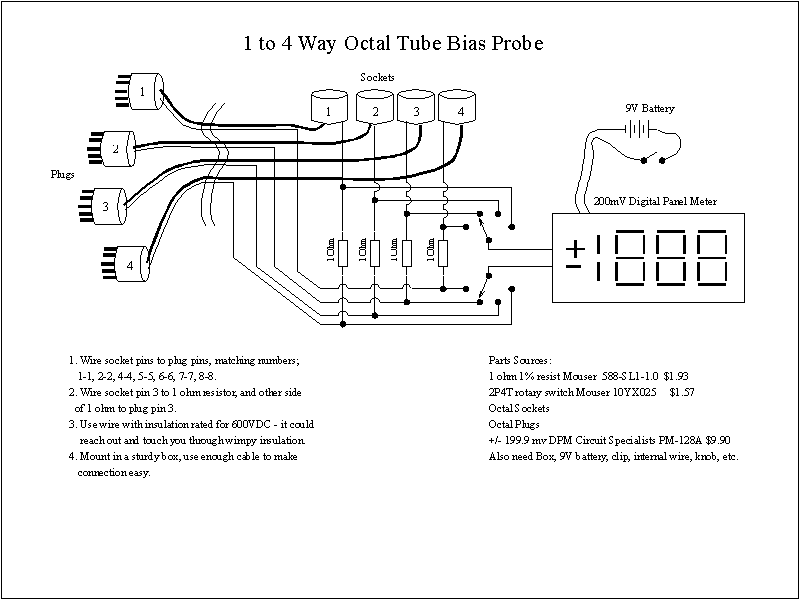
Hi. geofex has nice one http://www.geofex.com/FX_images/biasprob.gif
I'll tell you all my secrets, but I lie about my past.
Re: DIY Bias probe.
Andy, How do you reference to ground on your box? Do you just wire the black test jack to the box?
And regarding the geofex schematic. Why is the resistor on the plate. Shouldn't the resistor be on the cathode?
And regarding the geofex schematic. Why is the resistor on the plate. Shouldn't the resistor be on the cathode?
Re: DIY Bias probe.
The Geofex schem is a typo, should be pin 8. Of course, Andy is right, you need the plate voltage as well to have all the info to bias properly, I just assumed the OP knew that since he has made a lot of posts to this forum.
So, I drew this up according to Andy's specs, what do you think ? :
So, I drew this up according to Andy's specs, what do you think ? :
You do not have the required permissions to view the files attached to this post.
Re: DIY Bias probe.
Yes I realize I still have to do all the math. All I want do is be able to read my cathode current in mA with my meter without having to add a 1 ohm resistor from cathode to ground inside the amp.
Thx for the drawing KT66, I will try build it according to it. Those are both DPDT switches, correct?
Cheers,
Ronald
Thx for the drawing KT66, I will try build it according to it. Those are both DPDT switches, correct?
Cheers,
Ronald
-
Andy Le Blanc
- Posts: 2582
- Joined: Sat Dec 22, 2007 1:16 am
- Location: central Maine
Re: DIY Bias probe.
I had a blown fender deville that I scabbed, I used the tube sockets, they had long
pcb mount pins, OMRON PL08, japanese made.
Basically the ground connection ( pin 8 ) is interrupted, brought out the box,
thru a 1 ohm, then back to the socket. A plate lead is brought out to box
to switch and then a tip jack so I could A/B and disconnect the tip jack from the V+.
You can safely measure V+, use a momentary switch, check for balance,
and get individual ma. readings in the simplest and safest way.
Rat Sack parts, my AC is all over the place so I've never bother to use any better than 5%
anything, sounds better that way, it ain't rocket science, tube's are 20% devices
that drift all over hells half acre any way, no point.
pcb mount pins, OMRON PL08, japanese made.
Basically the ground connection ( pin 8 ) is interrupted, brought out the box,
thru a 1 ohm, then back to the socket. A plate lead is brought out to box
to switch and then a tip jack so I could A/B and disconnect the tip jack from the V+.
You can safely measure V+, use a momentary switch, check for balance,
and get individual ma. readings in the simplest and safest way.
Rat Sack parts, my AC is all over the place so I've never bother to use any better than 5%
anything, sounds better that way, it ain't rocket science, tube's are 20% devices
that drift all over hells half acre any way, no point.
lazymaryamps

Re: DIY Bias probe.
you can get all the parts at weber or tubesandmore i think you can buy a premade just probe to plug into a Multi meter for $20-25. might be worth buying versus the time to make.
My Daughter Build Stone Henge

Re: DIY Bias probe.
I would much rather drill some holes for test jacks and solder 1 ohm resistors on the cathodes than mess around with all that stuff.
I put the bias pots so I can adjust them from the top of the chassis.
I found some nice PEC pots that have a locking collar nut so once you set the bias where you want it, you just tighten the lock nut.
I liked it so much I added another one. (50 watt) so I can adjust each side independently.
It really makes it convenient and easy to adjust.
Because once you are aware where the plate voltage likes to sit, you can pretty much bias the amp without pulling the chassis or plugging in sockets and such.
I put the bias pots so I can adjust them from the top of the chassis.
I found some nice PEC pots that have a locking collar nut so once you set the bias where you want it, you just tighten the lock nut.
I liked it so much I added another one. (50 watt) so I can adjust each side independently.
It really makes it convenient and easy to adjust.
Because once you are aware where the plate voltage likes to sit, you can pretty much bias the amp without pulling the chassis or plugging in sockets and such.
Tom
Don't let that smoke out!
Don't let that smoke out!
-
Andy Le Blanc
- Posts: 2582
- Joined: Sat Dec 22, 2007 1:16 am
- Location: central Maine
Re: DIY Bias probe.
I still use it as bench tool for 6v6 and 6l6 amps.
Bias is never the same twice, just keep it close give or take ....
Bias is never the same twice, just keep it close give or take ....
lazymaryamps
-
Prairie Dawg
- Posts: 156
- Joined: Sun Jan 10, 2010 2:19 am
- Location: Windsor Heights, Iowa
Re: DIY Bias probe.
Then the Hoffman kit is for you. I built a couple of them in about thirty minutes and they work swell. Of course you have to remember that your multimeter is going to be in series with the cathode. What that should tell you is it's time for two inexpensive dedicated multimeters for this task.tribi9 wrote:Yes I realize I still have to do all the math. All I want do is be able to read my cathode current in mA with my meter without having to add a 1 ohm resistor from cathode to ground inside the amp.
Thx for the drawing KT66, I will try build it according to it. Those are both DPDT switches, correct?
Cheers,
Ronald
If you believe in coincidence you're not looking close enough-Joe leaphorn
-
maint_tech

- Posts: 28
- Joined: Tue Feb 20, 2018 2:58 am
Re: DIY Bias probe.
Sorry to resurrect and ancient thread but,
Has anyone tried to make a self-contained bias probe from one of these?
https://www.amazon.com/LM-YN-Digital-Vo ... 639&sr=8-1
Seems like it could be adequate for the task, no?
Has anyone tried to make a self-contained bias probe from one of these?
https://www.amazon.com/LM-YN-Digital-Vo ... 639&sr=8-1
Seems like it could be adequate for the task, no?
Re: DIY Bias probe.
No. The lowest display resolution is 10mV or 10mA. Needs to have at least 1mV or 1mA resolution.Seems like it could be adequate for the task, no?