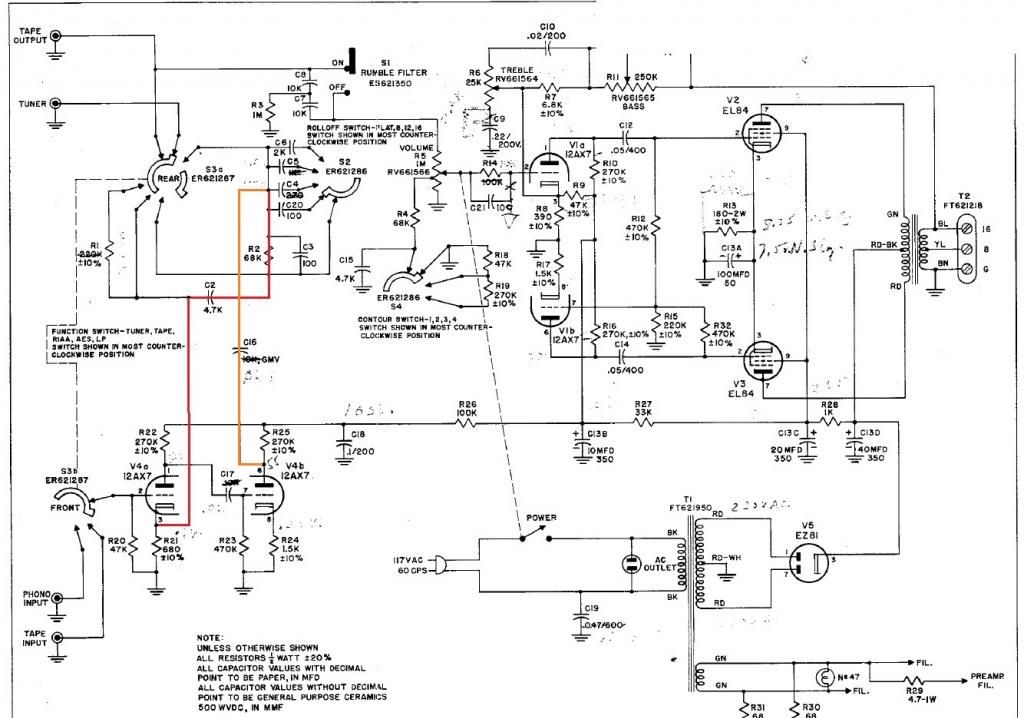
I've begun a conversion of a mid-1950s Harman Kardon "Prelude" from a 10 watt, 6V6-powered (cathode biased), tube rectified hi-fi mono amp to a 6L6GC powered guitar amp (using Tremolux-level transformers, a GZ34 rectifier and both cathode and fixed bias if that turns out to be feasible).
I know that some here are on TDPRI as well, and my build thread was started there back in May (in "Shock Brothers DIY Amps"). I'm not a fan of bumping my own threads there, so I thought I'd ask my pressing question here.
The schematic for the EL84-powered version of the Harman Kardon "Prelude" below shows a connection from the cathode of the preamp tube's first triode to the plate of the second triode. The 6V6 version is substantially the same. Could someone please tell me the purpose of this circuit? It doesn't appear to be a cathode follower.
Thank you very much, tele_player and teemuk! I see that now. I was thinking of the signal flow going from cathode to plate, but it's feedback from plate to cathode.
I've eliminated the switch, thereby eliminating the caps and resistors mounted on the switch, but I preserved that circuit to a certain degree. I do like the "voice" of the stock preamp so if it works out well after the power stage increase I'll keep it.
Plan "B" is to remove the stock PC board if the traces can't handle the increased voltage or if there's too much noise, and go with a Garolite turretboard with a simpler preamp.
 718]http://i916.photobucket.com/albums/ad5/ ... 24bb02.jpg[/img]